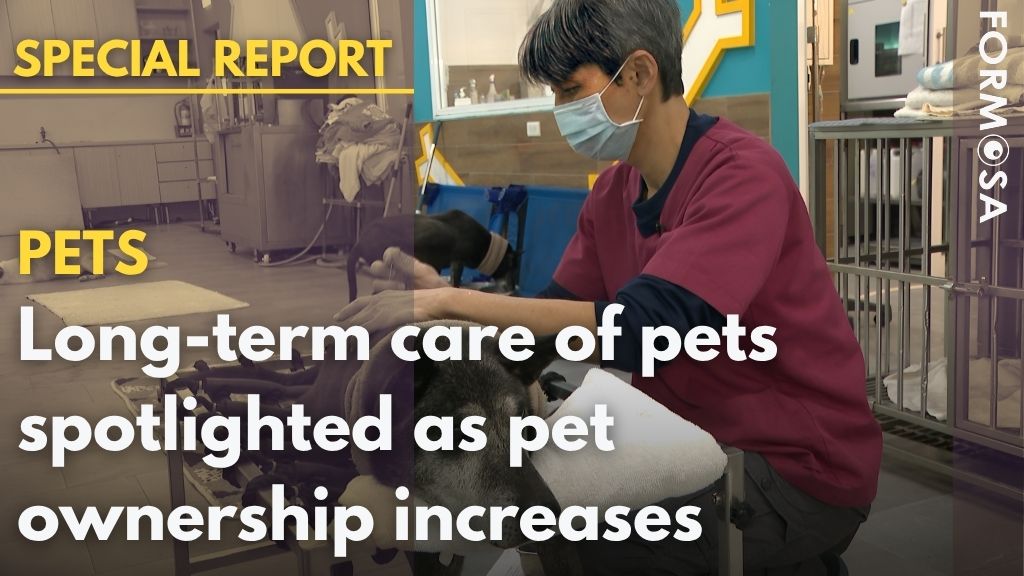
Long-term care of pets becomes central as ownership increases
In Taiwan, the number of pet cats and dogs have surpassed the number of children aged 14 and under. Instead of having children, more and more people are keeping pets, treating them like their own furbabies. But even though pets are dependent on their owners their whole life, they won’t stay as “babies” forever. Like humans, they could get chronic diseases in old age and require frequent medical treatment. Of course, there are owners that choose to give up their aging pets, but what should responsible owners be prepared for? Let’s find out more in our special report.
This is the long-term care center at New Taipei Zhonghe Animal Shelter. All the dogs here are over the age of 12, also known as geriatric dogs. Even though it’s an open space with plenty of room for them to move freely, many of them look unsteady on their feet, and some can only lie down.
Humans age, and so do other animals, at a faster pace. Dogs have a higher metabolic rate than humans, and they also age five to seven times faster. At 7, they’re considered senior already. Age 14 for a dog is around 88 for humans.
Furball the Pomeranian here is already 18 years old, 90 in human years. It’s given medication for heart disease. Pets are living longer than ever thanks to advancements in animal healthcare. But on the other hand, living longer also means they could develop joint problems and other chronic diseases.
Chang Hsuan-yu
Veterinarian
A common problem is chronic kidney disease. Most people are also aware that joints degenerate because of wear and tear with each use. It’s inevitable. There’s also nerve problems, as well as heart, intestinal and liver problems. In older dogs, they may eat less and less, and you may notice that their weight is constantly decreasing.
The fridge is stocked with more food for dogs than humans. Ho Tsung-hsun, secretary-general of Taiwan Animal Protection Monitor Network owns Chi-hsin the Husky with his flatmate. For the past nine years, he’s taken care of her like his own child, preparing three meals and snacks every single day.
Ho Tsung-hsun
Owner
I went through many trials and errors to get to this meal plan, which is also the healthiest. Many rescuers suggest having three staple vegetables: cabbage, broccoli and carrot. This prevents cancer and is the healthiest, including for humans.
Ho’s learned to make meals for his little one. But no matter how nutritious, Chi-hsin could get tired of the same meals over and over, so there’s also a range of seasonings.
Ho Tsung-hsun
Owner
You have to make the meals feel different, so I have all kinds of seasonings. Even humans can’t stand having tofu every day. Wouldn’t you also get tired of having biscuits every day? It’s the same with animals. There has to be variety. You can’t only have this. Of course, she may feel differently, and it may be human projection.
As a senior dog, Chi-hsin is starting to show signs of aging. She’s no longer as lively and also ambivalent about playing. She’s also diagnosed with cholecystitis, requiring regular follow-ups with the vet. However, pets aren’t covered by universal healthcare, making each visit very costly.
Ho Tsung-hsun
Owner
Even though it’s only been a little less than two months, I’ve already spent around NT$15,000, really a lot of money. For a human, three visits to the doctor is only NT$600, so I really didn’t expect to spend so much. After every visit, the vet asks if you’d like to follow-up, which would cost another 2,000 to 3,000. But do you really want to risk it worsening? So it’s an expense that you can’t cut.
Ho may spend a lot of money, but he’s also lucky enough to work from home and be with his dog. Most office workers can’t. On top of the expenses, they may also feel like they can’t spend enough time with aging pets.
Momo the Shiba Inu is 16 years old. After it developed heart disease, the owner no longer had the capacity to take care of it, so it’s put under long-term care at the animal hospital.
In 2024, the number of dogs and cats over the age of 7 accounted for 47% of the total. The market for older pets is estimated to worth at least NT$15 billion. Some animal hospitals in Taipei offer day-care. Owners can drop off their pets before the workday and fetch them after work. That costs NT$600 to NT$900 a day. There’s also long-term care, at NT$1,200 to 1,600 a day. Treatment and meals are billed separately.
Chang Hsuan-yu
Veterinarian
It’s the same with older adults admitted to nursing homes. Many older adults worry that their kids are abandoning them when they’re admitted. But that’s not necessarily the case. Adult children have their own lives and may also be busy with work. It’s the same with animals. You can’t possibly take care of them all day long. You need to help them change positions, feed them, clean up after them. But if we have neither the time nor capacity, the animals may actually be worse off if continued to be kept at home.
Some owners are willing to shell out for day care and long-term care. But not all older pets are so lucky. Many rescued dogs at the animal shelters are so old that they could no longer stand. They were most likely abandoned.
Huang Chi-ting
Vet and Zhonghe Animal Shelter director
It must’ve had an owner before considering how old it is. Strays don’t usually live to become so old. Most strays won’t survive past the age of 10, because they easily get into accidents. There could be cars or other injurious scenarios in the wild.
With limited staff, the shelter residents can’t really be taken care of one-on-one. And so members of the public are encouraged to adopt older pets.
Huang Chi-ting
Vet and Zhonghe Animal Shelter director
Every single one of them need to take painkillers and joint supplements, requiring frequent medical intervention. It really adds to the burden of frontline workers, whether physically or psychologically. An animal protection officer may have just put down pee pads and soon they’ll get soiled, and then there’s cleaning up to do. It really makes the job complicated for them.
Chu Chan-sheng has treats ready for geriatric dogs at the shelter. He can’t bear seeing them living their last days without their owners, so he tries to adopt as many as he can.
Chu Chan-sheng
Pet owner
We had older dogs at home before. After many years, they became old and ran into medical problems. This all became lived experience. We’d take the vet’s advice and learn how to take care of them and what their treatment requires.
As a real estate agent, Chu’s schedule is quite flexible. He had nine dogs at one point. But how did he plan for them financially?
Chu Chan-sheng
Pet owner
Vets charge based on their weight. We had a dog that weighed more than 30kg. The medical costs until it passed away was at least NT$400,000. My partner and I are frugal. We try to be as frugal as we can on our own expenses. It’s okay if we don’t get to have as many luxuries, but we can’t cut their medical expenses. We try to save with our own expenses.
Chu currently has adopted two geriatric dogs and one cat. One of the dogs has dementia and has to be tube fed.
Chu Chan-sheng
Pet owner
It doesn’t know where food is, or where water is, so we have to tube-feed it. It also keeps walking. If you don’t make it rest, it’ll just keep going and going. It wouldn’t know when to stop and rest.
Not all owners are so patient with aging and sick pets. Some may even take out anger on them.
Recently, a 15-year-old Corgi with dementia was filmed while beaten by its owner because it had releved itself where it shouldn’t. The owner posted the video online, hoping to gain sympathy. Instead, he was widely condemned.
Chu Chan-sheng
Pet owner
When pets have this kind of behavior, it’s really not out of their own will. It’s just a natural part of aging. The owner taking his anger out on the dog doesn’t solve the problems. I think it’d be better for him to seek advice from other owners of dogs with dementia. That way, I believe he’d have it easier.
Even though the animal shelter encourages adoption, few adopters ever show up. So the geriatric dogs have to make do with government funding until death. If not for incurable diseases or loss of mobility, and if they still have normal appetite and energy levels, the animal shelter won’t consider putting any of them down.
As for pet owners, they can consult a vet if they’re considering euthanasia.
Chang Hsuan-yu
Veterinarian
Let’s say that the future you foresee is just worse and worse by the day. If the quality of life is so low that it’s stopped eating and could only be tube fed, or if it’s lost all function, or if you’re noticing that the pet is unhappy or suffering every single day, then I’d suggest that the owner let them become an angel.
In the end, it’s still up to the owner. But there will be a point when the medical bills just get too overwhelming and you’ll have to make up your mind.
People may want pets for amusement or companionship. But no matter the reason for getting a pet, it’ll eventually become old and frail. Would you stand by it until the last moment, or leave it to an animal shelter? Do you know what to expect for a pet’s future?
Huang Chi-ting
Vet and Zhonghe Animal Shelter director
We hope that before getting a pet, every owner understands that animals need long-term care and plans accordingly, so that their pets would live happily until the end.
#pets #animals #dogs #cats #geriatricpets
For more Taiwan news, tune in:
Mon to Fri at 9:30 pm on Channel 152
Tue to Sat at 1 am on Channel 53
2026-08-24