NSYSU partners with University of Arizona on silicon photonics center
NSYSU partners with University of Arizona on silicon photonics center
2026-09-09
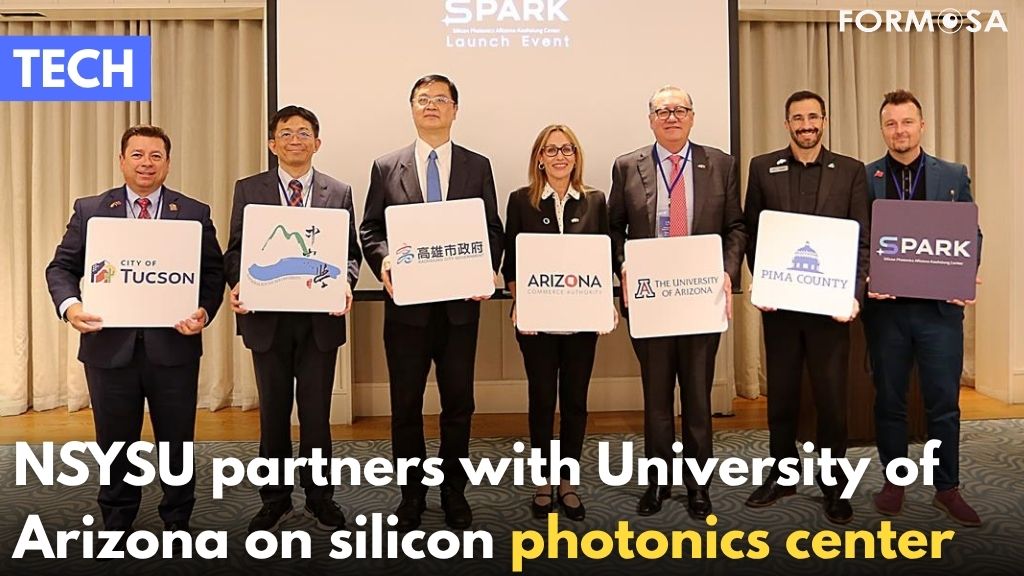
As the AI computing race enters a new stage, data transmission speeds and energy consumption have become critical bottlenecks. To tackle the issue, National Sun Yat-sen University has partnered with the University of Arizona to establish the Silicon Photonics Arizona-Kaohsiung Center, or SPARK. It will join forces with over 20 tech enterprises across Taiwan and the US to develop key AI technologies and international talent.
As the race to build out AI computing power heats up, data transmission speeds and energy consumption have become major bottlenecks. National Sun Yat-sen University and the University of Arizona in the US have joined forces to establish a center for silicon photonics, called SPARK, to advance these key technologies.
Li Chih-peng
NSYSU president
For this collaboration, we’re not just focusing on technology research. We also hope to cultivate more talent. The University of Arizona is considered to have one of the best optics centers in the US, while our university has extensive experience in silicon photonics development and packaging.
The center brings together more than 20 tech companies from Taiwan and the US to expand cooperation in talent cultivation and tech research across industry and academia.
Lo Ta-sheng
Kaohsiung Deputy Mayor
The city government will actively participate in SPARK. We’ll establish a fund for the University of Arizona, Sun Yat-sen University, the Kaohsiung City Government, and the Arizona State Government to all take part. With this fund, we hope to stimulate collaboration between industry and academia.
Li Chih-peng
NSYSU president
Looking ahead, beyond developing key technologies, especially in silicon photonics, the center could help usher in the next generation of semiconductors. Computing speed and energy efficiency represent the most needed technologies in the field.
In addition to cultivating talent, the center aims to have a hand in the next generation of chip technologies. SPARK will connect companies across Kaohsiung and Arizona, deepening exchange between Taiwan and the US in R&D, talent, and industry cooperation.
#semiconductors #siliconphotonics #NSYSU #UniversityofArizona #chips #Kaohsiung #SPARK
For more Taiwan news, tune in:
Mon to Fri at 9:30 pm on Channel 152
Tue to Sat at 1 am on Channel 53
AI時代來了! 中山大學攜手亞利桑那大學創"跨國矽光子中心"
2026-09-09
AI算力競賽進入新戰場,資料傳輸速度和能耗成為關鍵瓶頸,中山大學攜手美國亞利桑那大學成立跨國矽光子中心,結合台美超過20家科技企業,搶攻AI時代關鍵技術,也要培育跨國科技人才。
AI算力競賽進入新戰場,資料傳輸速度跟能耗成為關鍵瓶頸,中山大學攜手美國亞利桑那大學成立跨國矽光子中心,要搶攻AI時代的關鍵技術。
[[中山大學校長 李志鵬]]
“那這個合作呢,我們不只是在這個技術的研發上面,我們也希望能夠培育更多的人才,那亞利桑那大學,可以說是全美國最好的這個光學中心,那我們中山大學,在矽光子元件的開發還有封裝,有非常深厚的這個經驗”
這個跨國矽光子中心結合台美超過20家科技企業,從人才培育、技術研發到產學合作,擴大雙方交流。
[[高雄副市長 羅達生]]
“在SPARK計畫,我們市府也會實質的參與,所以我們會成立一個基金,讓這個亞利桑那大學,還有中山大學,還有市政府,還有亞利桑那的這個州政府等,都會一起來參與,藉由這個基金的設立,我們希望能夠帶動相關的一個學術的合作以及產學的合作”
[[中山大學校長 李志鵬]]
“我想未來這個中心,除了扮演這個關鍵技術的開發,尤其在矽光子方面,那矽光子可以說是半導體的下一個世代的未來,它不管在運算的速度,還有在節能方面,這都是半導體最需要的技術”
除了人才培育外,中心也瞄準半導體下一世代的關鍵技術,未來SPARK將串連高雄與亞利桑那的半導體產業聚落,從技術研發、人才到產業合作,深化台美科技交流。
更多新聞內容,請鎖定:
民視台灣台(152頻道)週一至週五晚上9:30
民視新聞台(53頻道)週二至週六凌晨1:00
Related News