Taoyuan temple celebration blends tradition and innovation to attract youth
Taoyuan temple celebration blends tradition and innovation to attract youth
2022-09-04
The Daxi Daxi festival is held annually in Taoyuan to celebrate the birthday of a prominent folk religion deity. It’s always been a major event, but in recent years organizers have noticed that most of the participants are not exactly young. Amid concerns that the festival is losing its appeal, organizers began looking for ways to modernize the event. By cooperating with young designers, the festival now features electronic music, colorful imagery and futuristic robotic costumes, which seem to have kicked off a revival. But how does the festival balance tradition with innovation? Join us as we hear from the festival’s performers, designers and organizers on how creativity is bringing new life to Daxi Daxi.
It’s the start of the lunar calendar’s sixth month, and as usual for this time of year, crowds are gathering at Puji Temple in Taoyuan’s Daxi District. Temple officials are also here, paying their respects to folk deity Lord Guan.
The 24th day of the lunar calendar’s sixth month is Daxi Daxi – a folk festival celebrating Lord Guan’s birthday. The festival is the temple’s biggest event of the year.
For the people of Daxi District, the lively festival is like a second Lunar New Year. Lord Guan’s birthday and the eve of that day – which this year fall on July 21 and 22 – are the grand finale of the festival, when Lord Guan goes on tour. However, Daxi Daxi is a 21-day affair, and revelers celebrate throughout the full three weeks.
Under the skillful command of temple performers, auspicious dragons and lions dance about. Throughout the day, 31 local temple performance troupes fill Daxi Old Street commanding a captivating sight. At night, the festival continues back at the temple, with a vibrant light show and electronic music party.
Traditional folk music is adapted to modern styles, inviting revelers both young and old to throw up their hands and give in to the atmosphere.
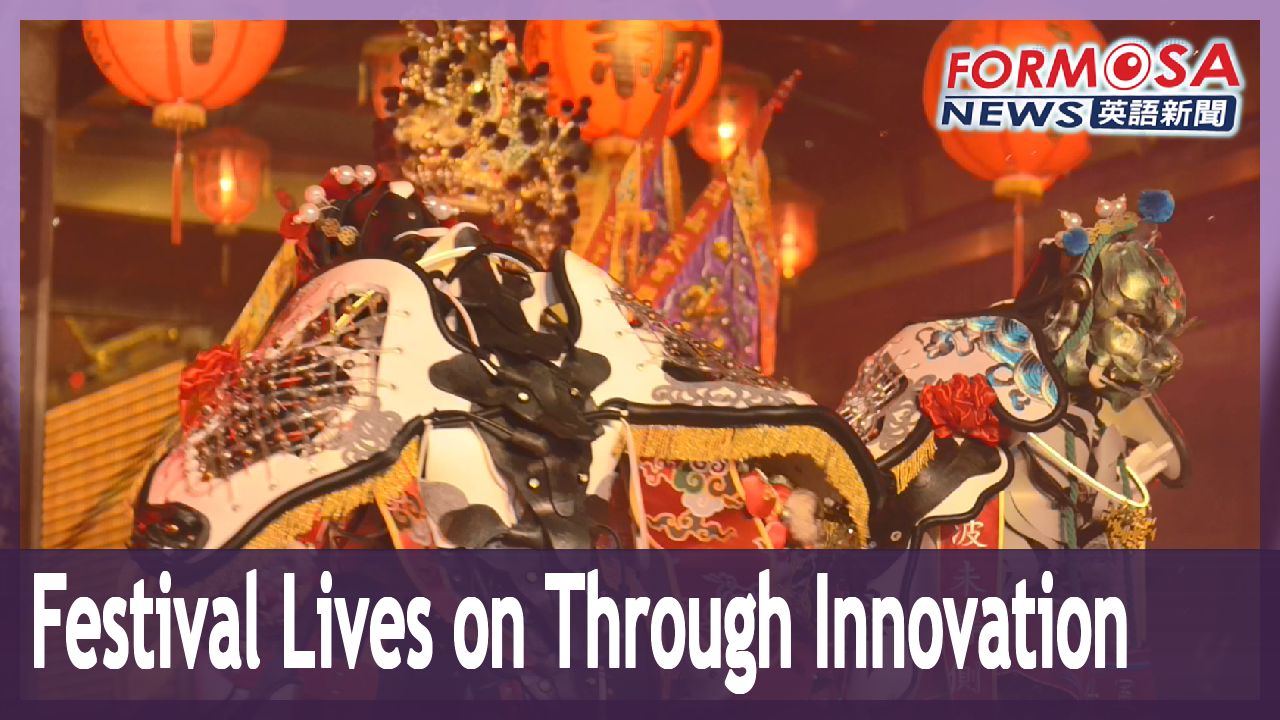
Two dancers clad in robotic deity costumes step out from the shadows and the crowd goes wild. Representing the deity generals Zhou Cang and Guan Ping, the dancers’ costumes emit light from their breastplates and upper backs, as they dance in unison before the crowd.
This modernized festival – which has proved popular with younger crowds – is the result of nearly five years of development. Puji Temple began working with costume and exhibit designers in 2019 to come up with new performances for the festival. This year the organizers introduced a festival theme song, and are holding concurrent exhibitions near the temple. Daxi Daxi has a history spanning over 100 years, and this year may be Lord Guan’s most fashionable birthday to date – but will the district’s elderly be able to accept the changes?
Designers struggle with how to strike a balance between tradition and innovation.
Nestled in the industrial area of Taipei’s Shilin District, is the studio of designer Lee Yu-sheng – one of the architects of the modern Daxi Daxi festival. Stepping into the studio, one’s attention is immediately drawn to the two robotic deity costumes from the festival.
Lee Yu-sheng
Costume designer
These two divine generals greet people as they come in. They are the all-seeing god and the all-hearing god. They are like two glowing giants in the night. For people who don these costumes, they also light the way. I think it’s a way of using modern technology, to manifest divine power – I guess by relying on light and sound.
From the robotic divine generals, to the depictions of Taiwanese animal deities that debuted at this year’s Daxi Daxi, and even the festival banner – all of these creations are the works of Lee.
Lee Yu-sheng
Costume designer
Lord Guan is Puji Temple’s main deity, and at the very top everyone can see the Five Tiger Generals. These traditional folk beliefs, and traditional temple festivals – people are most worried that these things will be lost to time, just like what we saw with the ban on incense at temples. So, there are young people bringing new takes and innovations to these traditions, like what we are seeing at Daxi Daxi, and this has been well received.
Reform is not without struggle. Innovation must contend with strong traditions, and change can only take place through compromise.
This year, organizers invited Hsinchu City’s protecting deity, Cheng Huang Ye, as a special guest at Daxi Daxi. In traditional fashion, the Hsinchu City God Temple’s administrators wanted to have auspicious notices pasted up along Daxi’s streets to announce Cheng Huang Ye’s procession route. To their surprise, the request was met with reservations from some festival organizers.
Liu Chen-jung
Daxi Daxi organizer
When it comes to the elderly, you are dealing with a background of a hundred years. In that hundred years are many hundreds of years of stories. With religious matters they may feel that you don’t understand them. You have to do lots of homework, and you have to tell them, “I may not fully understand you, but I will try my best. You can teach me.”
Puji Temple administrators and performers agreed to the Hsinchu temple’s request, deciding it could inject a new element into the celebration. But how much could Daxi Daxi be reformed, and what should the bottom line be? Only trial and error would tell.
Hsieh Chang-ming
Puji Temple chairman
Some committee members were concerned that, on the folding card used to hold the festival’s commemorative talisman, only the words “Daxi Daxi” were written – the words “Puji Temple” were absent. The committee members argued that the talismans are meant to be taken to the temple to be blessed, and then taken home to provide protection. So, the committee members took issue with only including the words “Daxi Daxi” on the card.
Liu Chen-jung
Daxi Daxi organizer
In the beginning he even said he didn’t want to use the card. He said, “This is no good, I’m not paying for this.” So, I made a very elegant sticker to put on the cards, which had “Puji Temple” written in both Chinese and English. It reminded him of a stamp, and it fit the card perfectly.
Disputes are inevitable in the process of reforming Daxi Daxi, but communication and reconciliation are part of that process too – and the hard work of these innovative youth has not gone unnoticed by Puji Temple.
Chiang Chih-cheng
Daxi Folk Arts Association
Even when people complain to them, they don’t snap – they’re very dedicated. When the performers come to them with requirements, they accommodate everyone. They rarely say “No.”
Hsieh Chang-ming
Puji Temple chairman
They are really quite hard-working. For example, when we are filming advertisements, or hosting activities where our deity shows up, they will be there working very hard – I’ve seen it. So, whenever some small problem comes up, we just take our time and resolve it.
Through respect for tradition and trust in innovation, the Daxi Daxi festival evolves and improves.
Watching the troupe perform one can learn about the divine generals. If that’s not enough, visitors can also watch the monitors and follow the movements of troupe captain Chang Shu-wu.
Chang Shu-wu
Jia Tian Temple director
About 10 years ago I realized something. Those carrying around the sedan chair on pilgrimages are all in their 40s, 50s or older. There’s nobody younger than that. It made me think, what can we do to ensure the preservation of this culture?
Hoping to pass on the temple’s traditions to future generations, Chang took on the task of training performers for Daxi Daxi, and established a course to train performers outside of the festival period. Chang also wrote his own book to outline the steps of the performance.
Chang Shu-wu
Jia Tian Temple director
In the past, all this was passed on orally. What I worry about now is, when I’m teaching this stuff, what if the student forgets some small detail. Then when they teach someone, that person forgets a detail, and so on. So, our thinking is, we need to take the visual aspects of this performance and transform them into words for preservation – turning the performance into a script. I hope that what I teach is fellow teachers, and not just performers.
Through those who pass on the temple’s traditions, festivals like Daxi Daxi can live on in new ways.
Cheng Yao-lin
Puji Temple
Since we started holding this festival, my son would come home from school, and he would go and participate in temple challenges with his classmates. When he passed the challenges he would get talismans as gifts. He would be so happy, and he’d show them off to me. As fathers, when we see our children so happy, of course that also makes us so happy.
Cheng Wen-tsan
Taoyuan mayor
This kind of festival is not just about going on pilgrimages and setting off a bunch of firecrackers, it’s about creativity and cultural meaning. I think this transformation is something that was needed, and it’s been a success – and it’s what the people of Daxi wanted to see.
Daxi Daxi brings the people of the district together, and unites them through the fervor and excitement of a shared tradition. Through innovation, it will continue to unite future generations.
與神同巡 廟會變潮了
2022-09-04
您聽過六廿四嗎?這串數字,可是認識大溪文化的密碼。每年的農曆六月二十四,是關聖帝君的生日,也是大溪當地一年一度的盛會。除了當地民眾組成的31個陣頭會抬神將、拚場表演外,關公也會親自出巡遶境,熱鬧程度就像是大溪人的第二個過年。只是傳統的廟會也會面臨永續傳承問題。這幾年,在創新團隊的加入下,大溪六廿四慶典,不只重新設計關公和神將的視覺意象,也規畫周邊展覽、市集,還有長達21天的「暖壽活動」!傳統廟會變潮了,是否就能成功吸引年輕人呢?一塊到現場去看看!
農曆六月一到,來到桃園大溪普濟堂拜拜的人潮漸漸多了起來,今年負責舉辦「六廿四」慶典的幾位要角,也全員到齊,來跟關聖帝君請安。
每年農曆六月廿四日,是關聖帝君、關公的聖誕,也是大溪普濟堂一年一度的盛會。
熱鬧程度就像是,大溪人的第二個過年,今年除了壓軸兩天,農曆六廿三、六廿四,也就是國曆的7月21到22日,有關公出巡活動外,還加入了長達21天的「大溪大禧」暖壽慶典,為為期兩天的關公遶境活動,提前做慶祝。
飛龍在天,祥獅獻瑞,白天大溪在地31個陣頭,也是當地人所稱的「社頭」擺陣拚場,帶著頭旗、大仙尪,繞遍大溪老街。晚上,普濟堂廟埕,則搖身一變,上演「廟會版」電音派對。
民俗音樂經過改編,聽起來現代又前衛,熱烈氣氛讓現場老少觀眾,忍不住跟著舞動雙手。
讓人眼睛一「亮」的「電氣神將」,一出場,全場氣氛嗨到最高點,兩尊創新的「電氣神將」,胸前背後都有發光裝置,與大溪在地社頭的周倉、關平,兩大神將,一起共舞,踩起將軍步,畫面竟然一點也不突兀。
這場讓年輕觀眾們,讚不絕口的新型廟會,其實已經歷經五年時間的進化,大溪普濟堂從2019年就開始與設計師,策展團隊合作,推出開幕表演,和專屬伴手禮。今年還有主題曲和將軍文化周邊展覽。但有著百年歷史的大溪六廿四,要一下就進化,變成「關公最潮生日趴」,老一輩的大溪人恐怕很難接受。
傳統與創新之間的分寸,初來乍到的設計策展團隊,該如何拿捏。
穿過台北士林工業區,來到「大溪大禧」主力設計師之一,李育昇的工作室,首先映入眼簾的,正是曾在大溪普濟堂廟埕,和神將共舞的兩尊「電氣神將」,千順兩大將軍。
[[劇場服裝設計師 李育昇]]
“這對放在玄關迎賓的神將,祂們是千里眼跟順風耳,在夜間是發光的巨人,是一個人體穿戴的燈光裝置,我覺得以現代的視覺,或是以現代科技來說,如何彰顯神力,可能就是靠這些聲光。”
從「電氣神將」,到今年首次亮相的,台灣特有種神獸,石虎獸,以及「大溪大禧」活動的頭旗,全都出自李育昇之手。
[[劇場服裝設計師 李育昇]]
“大溪普濟堂的主神,是關聖帝君,大家可以看到,最上面的是五虎將,傳統民間信仰、傳統廟會,它們最怕的是被時代遺忘,就是香火斷傳這件事,所以有新的年輕人,或是用新的角度去做創作,用新的角度去辦廟會,例如說「大溪大禧」,他們的接受度是很高的”
改革必定伴隨著痛楚當年輕世代的創新,強碰優良傳統,到底誰該讓步,還是有折衷之道,能讓雙方都點頭。
今年「大溪大禧」暖壽活動,請到新竹城隍爺來當開幕式貴賓,原本策展團隊,想依新竹城隍廟習俗,沿路貼香條昭告出巡路線,沒想到卻引起,桃園大溪普濟堂廟方大反彈。
[[大溪大禧策展人 劉真蓉]]
“面對到耆老,其實背後代表是百年的歷史,百年的歷史有很多百年的故事,宗教傳統這件事情,他們會認為你可能不懂,你必須做很多功課跟他們說,我可能沒有很懂,但我想盡辦法了解,你可以教我”
雖然普濟堂廟方和當地社頭都同意,要為關公聖誕慶典注入新潮元素,但改革到底可以多新多潮,底線又在哪,往往試了才知道。
[[大溪普濟堂主委 謝昌明]]
“有的委員在反映,紙架上面只有「大溪大禧」四個字,普濟堂名字沒有寫下去,我們的委員反映說,這些東西要到我們廟宇加持,再給信眾拿回去保平安,結果它只有「大溪大禧」,有一些委員就有一點意見”
[[大溪大禧策展人 劉真蓉]]
“他一開始還說我不要這個背卡,這樣不行,我拒付這個錢,就做了一個非常精美的貼紙,上面還有中英文寫個普濟堂,也讓他覺得像是一個章,很完美的放在這個平安符上面”
爭執、溝通、再到和解,是六廿四加入每個創意,必經的過程,而五年來,這群年輕人的努力,普濟堂廟方和社頭也看到了。
[[大溪民俗技藝協會總幹事 江智誠]]
“他們被唸都不會還口,非常有敬業的精神,對社頭大哥,每一個人的要求都點頭,很少在搖頭的”
[[大溪普濟堂主委 謝昌明]]
“他們也真的很認真,像有拍一些廣告、活動,我們的神將過來,他們也非常認真在做,我都有看到,所以有一點小問題,慢慢我們給它解決掉就好了”
尊重傳統,也信賴創新,進化後的六廿四廟會更好看了。
看將軍步,也學將軍文化,覺得體驗不夠,還可以到周邊的將軍展,透過體感互動裝置,跟著張書武的腳步一起踩。
[[大溪嘉天宮同義堂總幹事 張書武]]
“在十年前的時候,我發覺到一件事情,扛神將的年齡,是屬於在四、五十歲以上,再下來就沒有了,我想說我們是不是,該為這個文化留下什麼”
期盼將軍文化,薪火相傳,張書武不只在「大溪大禧」活動期間,擔任將軍步講師,平時也有開設社頭培訓班,甚至親自編纂教科書,用文字記錄下神將腳的一步一踏。
[[大溪嘉天宮同義堂總幹事 張書武]]
“因為以前都是口傳心授,我也擔心,我現在教的東西,教完我的徒弟,我的徒弟可能少學了某一個細節,他忘記了,當他教他的徒弟的時候,他的徒弟又忘記他的一個細節,所以我們就覺得,我們必須先把基本的圖像留下來,把它變成文字稿,希望我教的是老師,而不再只是神將腳”
廟會文化,後繼有人,大溪「六廿四」的故事,也以不同的方式被繼續傳頌下去。
[[興安社常務委員 鄭姚霖]]
“自從有辦這個活動之後,他回來會跟同學一起去通關、闖關,闖完之後拿到一個禮物平安符,他很開心,跟我炫耀,我們當爸爸的,看到小孩子開心,當然你也會覺得很開心”
[[桃園市長 鄭文燦]]
“不是只有傳統的遶境,一大堆鞭炮,而是充滿了文創,充滿了文化的意味,我覺得這個轉型是必要的,也是成功的,更是大溪人想看到的”
傳統又創新的六廿四慶典,吸引大溪年輕人回到家鄉,鬥鬧熱,從老到少,在廟埕團圓,一起度過屬於大溪人的第二個過年。
Related News