An NTU program inspired by the idea of a gap year encourages off-campus learning
An NTU program inspired by the idea of a gap year encourages off-campus learning
2023-01-08
A new program at National Taiwan University aims to encourage students to explore learning opportunities outside the classroom, while maintaining their student status. The program is designed to give students more freedom, without causing concerns for parents who are used to traditional classroom studies. The school hopes the program will broaden students’ horizons, and help them discover their interests. One of the program’s participants, Chang En-wei, says she has already learned a lot from her off-campus experiences working with animals. Let’s hear what she has to say in our Sunday special report.
She may be still a bit new to horse riding, but 19-year-old Chang En-wei and this horse already have a great rapport.
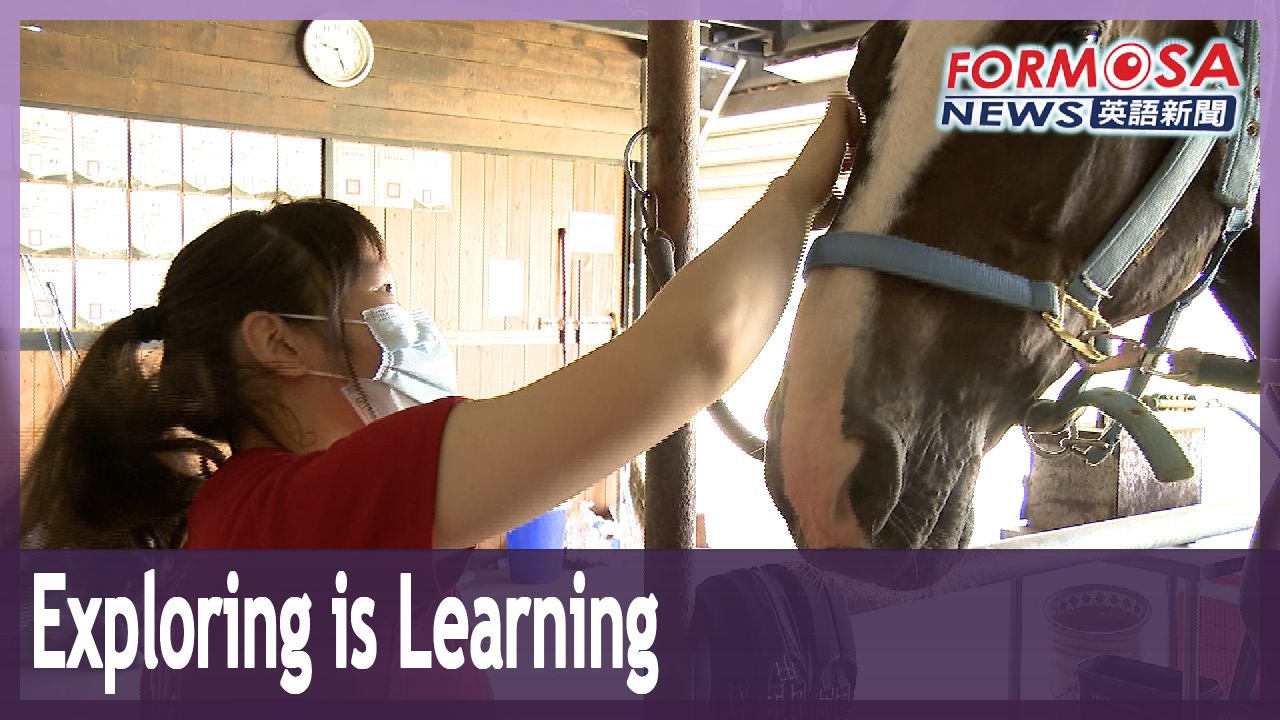
Chang, who is a student at NTU, says she feels a strong connection with this horse named Kiki. While her classmates are in lectures back at the university, Chang is here practicing riding with Kiki.
But it’s not only Kiki that Chang has formed a bond with. All of the stable’s horses, young and old, have become her close friends.
She says the horses have become her new classmates, and the stable her classroom. This unique experience is part of an experimental program at the university.
The school equates it to how students in other countries will take gap years before entering university, during which they travel and find new experiences, and explore interests. The gap year has also gained popularity in Taiwan, and this is NTU’s unique take on it. Students take one or two terms at the university, and then go off to explore their interests with off-campus learning experiences.
Chang Sheng-lin
National Taiwan University
We refer to this experience as being akin to wandering. We hope it will give students a bit of space, so they have the opportunity to let their thoughts wander. During that process they can discover what they truly enjoy, and figure out what they really want to study.
Chang’s motivation in applying for the program came from one unforgettable course in NTU’s Department of Agricultural Chemistry that left a lasting impression on her.
Chang En-wei
Student
When I was in the agricultural chemistry program, there was this biology course I took. We had to dissect a rat. What I found so horrifying is that to take out its brain we had to use this forceps, and they kept making this clicking noise. The sound spread throughout the classroom. I found it really horrible that, in order to understand living creatures, we have to sacrifice them.
To get over her experience in the biology class, Chang came to the stable to learn more about the horses there. Riding Kiki is only part of what she does there. Chang also helps out with other work around the stable, including brushing the horses.
Chang may have a special bond with the horses at the stable, but she knows that she needs other close-up experiences with animals for her studies to be more rounded. For that, she has come to the zoo.
Here she is learning about all of the difficult chores involved with caring for animals.
Chang En-wei
Student
I feel that pushing the wheelbarrow is super difficult. No matter how I push it, it tips over. Even after pushing it this long I still tip it over. The load is stacked so high, that balancing it is a bit of a challenge. I’m 153 centimeters tall, and the hay is stacked about as high as that. When the hay is stacked to the highest, I can’t see what’s ahead of me.
Through exploring their personal interests outside the classroom, students can carve a path for their future. However, despite the benefits of such a program, it will take time for some Taiwanese to embrace this non-traditional study model.
Chang Sheng-lin
National Taiwan University
If a student says they want to take a break from studies, normally the parents will be unable to accept that. So we worked with the Office of Academic Affairs, and slowly devised this system, which basically makes it so that participating students aren’t really on a hiatus, since they maintain their student status. However, it frees up a lot of time for them, so that they can go and do things they really want to do.
Her participation in the program also allows potential future employers to witness her passion for working with animals.
Huang Chun-wei
Horse riding instructor
We take in interns from many different schools here. They come here and do internships during the summer break. Sometimes they get to the third or fourth year of university, and they’re lost in terms of their future plans. They may make it to third or fourth year and decide, “Hey, this is not what I want to do with my life.” So, the fact that Chang can figure out so early what she likes, that’s going to be great for her development.
Liu Shih-chung
Leofoo Village Theme Park
Our internship program is more practical in nature, because in a zoo-like setting like the one we have here, there is no classroom for teaching. Students who come here think, “I love animals,” and that’s an important starting point. However, Chang is different in that she takes the time to learn more about the industry, and ask questions. I can see that she’s really thinking about things.
Chang En-wei
Student
I think if zoos can do a better job with their exhibits, that will create more space for communication with animal-rights activists, and allow for a better relationship with them. I hope that when the exhibits are being designed, zoos can act as a bridge between the animals and activists.
Students in the program take a year to explore their options. However, this style of self-directed exploration is new to Taiwanese students, while students in other countries already have a long history of taking gap years.
This man speaking fluent Chinese is Joe Baldock, a student at John Hopkins University who previously studied Chinese in Beijing. He had originally planned to do an exchange program in Nanjing this year, but due to the pandemic, he changed his plans and came to Taiwan instead.
Joe Baldock
Student
Since I studied Chinese in China, I sometimes encounter challenges in Taiwan. Taiwanese use many expressions that are different from those used in China.
To better adapt to life in Taiwan, Baldock is doing an internship at Taiwan NextGen Foundation. He and others from the foundation occasionally visit rural areas of Taiwan, and promote cultural exchanges with the people there.
Joe Baldock
Student
At the time I had only a superficial understanding of Taiwan. For example, I knew about bubble tea and night markets, and other food-related things. Aside from that I didn’t have a very deep understanding of Taiwan.
Experiencing different cultures in Asia, and learning about differences between China and Taiwan, gave Joe an appreciation for those cultures, and informed his views on international affairs.
Chen Kuan-ting
Taiwan NextGen Foundation
He recently published some important articles in international relations magazine The National Interest. I think that’s helpful in increasing Taiwan’s visibility.
Going abroad can be like enlarging one’s classroom, but for some Taiwanese, it’s possible to have a similar experience without leaving their shores.
Chang En-wei
Student
My experiences at Leofoo Village Theme Park, the stable and elsewhere have really taught me a lot of things, and expanded my imagination. I have many more people to share those experiences with, and have gotten closer to my ideals.
Teachers are invaluable guides for students, helping them find their path and expand their knowledge, but sometimes what students need is to go off and explore on their own. Perhaps one day other institutions in Taiwan will take a cue from NTU, and develop more self-guided study programs to help Taiwanese students discover their own paths.
教室外的流浪課
2023-01-08
從國小到國中、升高中再升大學,這一貫的升學制度,似乎是台灣大部分學生,從一出生就被規劃好的道路。但這個單元,我們要帶您來看,有些學生決定類休學,探索自我。這其實是學校探索學習計畫的一部分,學生可以花一兩個學期的時間,跳脫原本的升學節奏,暫時離開校園,體驗在學校裡面所看不見的世界。這其實有點像國外的Gap Year空檔年,花一段時間,遊歷世界找尋自我。但為什麼,像這樣在教室外的流浪,可能會成為他們生命中的重要養分呢?帶您了解。
雖然騎術略顯生疏,但今年19歲的張恩瑋,和身下的馬兒可是馬場裡的最佳拍檔。
和白馬Kiki擁有好感情,張恩瑋是一名台大的學生,當同學們在學校上必修課的時候,她卻上起了一堂另類課程,練起馬術。
不只和Kiki感情深厚,馬場裡的馬兒,無論老少,都是恩瑋無話不說的好朋友。
把馬兒當作同學,讓馬場成為教室,這麼獨特的求學方式,全都來自一個叫做「探索學習」的計劃。
「探索學習」類似於西方國家盛行的GapYear,年輕人在進入大學或職場前,到海外體驗尋常軌跡以外的生活,同時尋找自己真正的興趣,這股風潮吹進台灣後,演變出讓在學生以「類休學」方式,大學生可以花上一、兩個學期,到外面的世界找尋自我。
[[台大創新設計學院副院長 張聖琳]]
“探索學習它的小名叫做「流浪」,就是我們希望能夠幫學生撐出一點點空間,讓他們可以有機會,去讓自己的思維流浪,然後在流浪的過程裡面,他們可以找到自己真的喜歡什麼,跟到底想要學什麼”
恩瑋申請探索學習計劃的原動力,來自她所屬的農業化學系,一堂令人畢生難忘的課程。
[[探索學習計劃學生 張恩瑋]]
“我原本在農化系,也有生物課,解剖老鼠的時候,我覺得最恐怖的是,我們要把牠的大腦取出來,頭蓋骨用鉗子把它打開來,所以就是一直「咔咔咔」,整個教室都是「咔咔咔」的聲音,我覺得真的是太恐怖了,我在了解動物的過程當中,我真的一定要犧牲掉牠們嗎”
為了解除心中困惑,恩瑋實地來到馬場學習,然而表面光鮮亮麗的馬術訓練,其實只是馬場工作之餘的小消遣,真正的日常之一,是得每天替馬匹刷毛。
雖然對馬情有獨鍾,但恩瑋深知關於動物的學習,不能單一,想更了解牠們,還要進入另一個與動物零距離的場域,動物園。
除了瞭解動物可愛的習性,也得學會照顧動物的所有苦差事。
[[探索學習計劃學生 張恩瑋]]
“我覺得推推車超難的,因為我怎麼推怎麼倒,我到現在推還是會倒,因為它會有點高,平衡有點小困難,我153公分,乾草堆大概跟我差不多高,草堆到最高的時候,我可能會看不到前面”
學生靠著過程中的不斷摸索,一步步點亮未來的路,但這對習慣體制內教育的台灣人來說,要完全接受或許還有難度。
[[台大創新設計學院副院長 張聖琳]]
“如果是學生要休學的話,通常家長接受度是相對低的,所以我們才想辦法跟教務處,慢慢形成了這個等於協商出這樣的一個機制,讓學生並不是真的休學,他還是有台大的學籍,使得他空出非常多的時間,可以真的來做他想做的事情
恩瑋這場探索,也讓業界有機會看見她的熱愛。
[[馬場教練 黃君緯]]
“很多學校的實習生,我們這裡有在收,暑假的時候他們都會來實習,他們可能到大三、大四的時候,他們對未來還是一片迷茫,可能甚至讀到大三、大四的時候,還在想說未來可能,這個不像是我想要的,所以我覺得恩瑋提前可以先去了解這塊的時候,對她未來的發展也滿好的”
[[六福村動物管理部主任 劉適仲]]
“我們的實習內容,比較偏實務操作類型,因為一般來講,其實在動物園這個領域來講,是沒有學校在教導的,學生來都是覺得,我好喜歡動物,這是最基本的出發點,但恩瑋不一樣的是,她會花自己的時間去了解這個產業,去了解更多,甚至會提出一些問題,我可以看到她是有在思考的”
[[探索學習計劃學生 張恩瑋]]
“如果能夠把展場做得更好,那是不是跟動保團體能夠有更多的溝通的空間,讓我們可以有更良好的關係,所以我希望在做展場設計的同時,可以扮演一個動物園跟動保團體之間的橋梁”
利用一年的時間,確定自己一輩子的志向,當台灣學生開始嘗試Gap Year的探索學習時,其實在國外用類似形式遊歷世界的做法已行之多年。
在北京學會一口流利的中文,他是來自美國約翰霍普金斯大學的Joe,原本今年預計前往南京進行交換學生,卻因為疫情影響,意外將目的地改成台灣。
[[來台交換學生 Joe Baldock]]
“因為我是在中國學的中文,來到台灣就覺得有的時候適應真的很困難,因為台灣的用語確實有很多不同”
為了融入在地,在台灣世代教育基金會實習的Joe,偶爾會跟著參訪團隊深入台灣鄉野,促進文化交流。
[[來台交換學生 Joe Baldock]]
“當時我個人對台灣的了解還是比較膚淺,比如珍奶或者是夜市或是其他美食之類的東西,我覺得除此之外也沒有太深刻的了解”
深入體驗東方文化,也用心觀察兩岸差異,Joe的探索,不單單是認識異國文化,更是在過程中,形塑自己對國際事務的觀點。
[[台灣世代教育基金會執行長 陳冠廷]]
“他最近也剛在《國家利益》上面,發表一些重要的文章、期刊,我想這對台灣的能見度也有很大的幫助”
對跨國探索的學生來說,「出走」象徵的是更廣大的世界教室,但不離開家鄉的出走,或許也同樣能打破,教室和社會的邊界。
[[探索學習計劃學生 張恩瑋]]
“我覺得經歷了從六福村,馬場等等,這樣經歷一大串下來,我覺得真的學到很多東西,有更多的想像,可以跟更多的人分享,又更靠近了我的理想一點點”
搖鈴指引著鴕鳥行進的方向,如同在校園裡老師指引著學生的步伐,但也有人大膽決定,脫離社會眼光中既定的道路,在常軌與非常軌之間,駛出自己的康莊大道。
Related News