An NTU program inspired by the idea of a gap year encourages off-campus learning
A new program at National Taiwan University aims to encourage students to explore learning opportunities outside the classroom, while maintaining their student status. The program is designed to give students more freedom, without causing concerns for parents who are used to traditional classroom studies. The school hopes the program will broaden students’ horizons, and help them discover their interests. One of the program’s participants, Chang En-wei, says she has already learned a lot from her off-campus experiences working with animals. Let’s hear what she has to say in our Sunday special report.
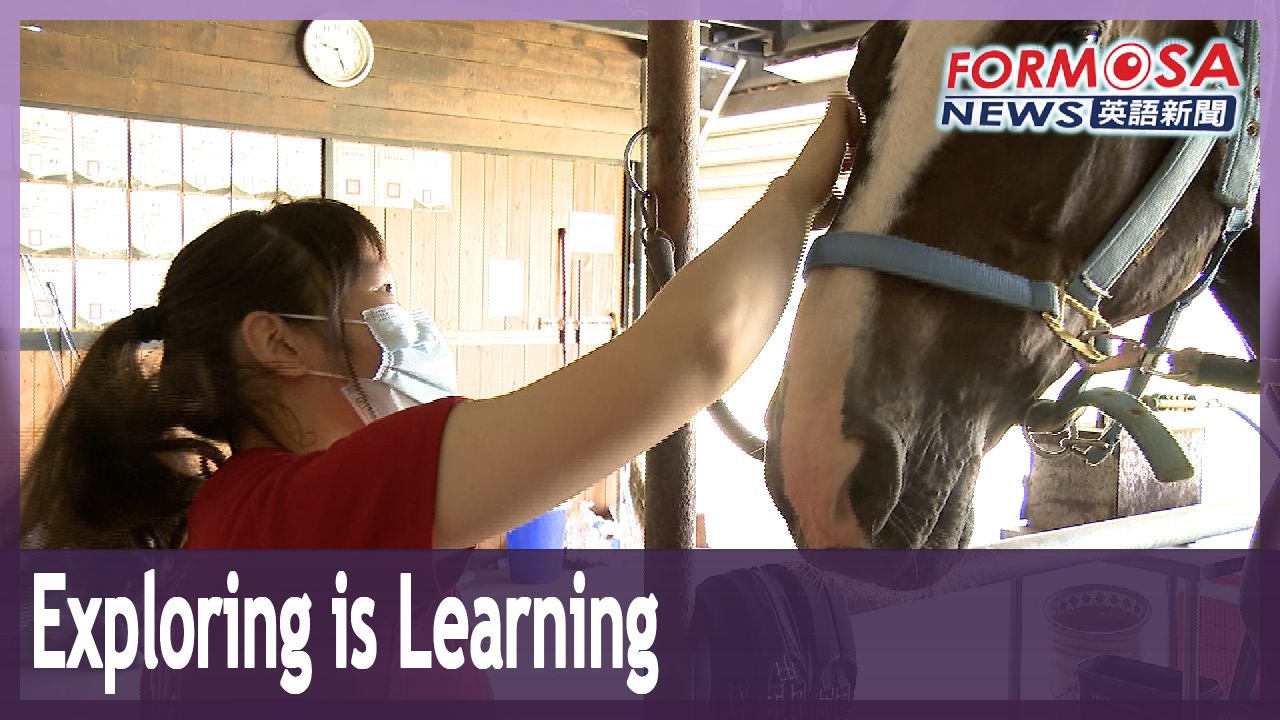
She may be still a bit new to horse riding, but 19-year-old Chang En-wei and this horse already have a great rapport.
Chang, who is a student at NTU, says she feels a strong connection with this horse named Kiki. While her classmates are in lectures back at the university, Chang is here practicing riding with Kiki.
But it’s not only Kiki that Chang has formed a bond with. All of the stable’s horses, young and old, have become her close friends.
She says the horses have become her new classmates, and the stable her classroom. This unique experience is part of an experimental program at the university.
The school equates it to how students in other countries will take gap years before entering university, during which they travel and find new experiences, and explore interests. The gap year has also gained popularity in Taiwan, and this is NTU’s unique take on it. Students take one or two terms at the university, and then go off to explore their interests with off-campus learning experiences.
Chang Sheng-lin
National Taiwan University
We refer to this experience as being akin to wandering. We hope it will give students a bit of space, so they have the opportunity to let their thoughts wander. During that process they can discover what they truly enjoy, and figure out what they really want to study.
Chang’s motivation in applying for the program came from one unforgettable course in NTU’s Department of Agricultural Chemistry that left a lasting impression on her.
Chang En-wei
Student
When I was in the agricultural chemistry program, there was this biology course I took. We had to dissect a rat. What I found so horrifying is that to take out its brain we had to use this forceps, and they kept making this clicking noise. The sound spread throughout the classroom. I found it really horrible that, in order to understand living creatures, we have to sacrifice them.
To get over her experience in the biology class, Chang came to the stable to learn more about the horses there. Riding Kiki is only part of what she does there. Chang also helps out with other work around the stable, including brushing the horses.
Chang may have a special bond with the horses at the stable, but she knows that she needs other close-up experiences with animals for her studies to be more rounded. For that, she has come to the zoo.
Here she is learning about all of the difficult chores involved with caring for animals.
Chang En-wei
Student
I feel that pushing the wheelbarrow is super difficult. No matter how I push it, it tips over. Even after pushing it this long I still tip it over. The load is stacked so high, that balancing it is a bit of a challenge. I’m 153 centimeters tall, and the hay is stacked about as high as that. When the hay is stacked to the highest, I can’t see what’s ahead of me.
Through exploring their personal interests outside the classroom, students can carve a path for their future. However, despite the benefits of such a program, it will take time for some Taiwanese to embrace this non-traditional study model.
Chang Sheng-lin
National Taiwan University
If a student says they want to take a break from studies, normally the parents will be unable to accept that. So we worked with the Office of Academic Affairs, and slowly devised this system, which basically makes it so that participating students aren’t really on a hiatus, since they maintain their student status. However, it frees up a lot of time for them, so that they can go and do things they really want to do.
Her participation in the program also allows potential future employers to witness her passion for working with animals.
Huang Chun-wei
Horse riding instructor
We take in interns from many different schools here. They come here and do internships during the summer break. Sometimes they get to the third or fourth year of university, and they’re lost in terms of their future plans. They may make it to third or fourth year and decide, “Hey, this is not what I want to do with my life.” So, the fact that Chang can figure out so early what she likes, that’s going to be great for her development.
Liu Shih-chung
Leofoo Village Theme Park
Our internship program is more practical in nature, because in a zoo-like setting like the one we have here, there is no classroom for teaching. Students who come here think, “I love animals,” and that’s an important starting point. However, Chang is different in that she takes the time to learn more about the industry, and ask questions. I can see that she’s really thinking about things.
Chang En-wei
Student
I think if zoos can do a better job with their exhibits, that will create more space for communication with animal-rights activists, and allow for a better relationship with them. I hope that when the exhibits are being designed, zoos can act as a bridge between the animals and activists.
Students in the program take a year to explore their options. However, this style of self-directed exploration is new to Taiwanese students, while students in other countries already have a long history of taking gap years.
This man speaking fluent Chinese is Joe Baldock, a student at John Hopkins University who previously studied Chinese in Beijing. He had originally planned to do an exchange program in Nanjing this year, but due to the pandemic, he changed his plans and came to Taiwan instead.
Joe Baldock
Student
Since I studied Chinese in China, I sometimes encounter challenges in Taiwan. Taiwanese use many expressions that are different from those used in China.
To better adapt to life in Taiwan, Baldock is doing an internship at Taiwan NextGen Foundation. He and others from the foundation occasionally visit rural areas of Taiwan, and promote cultural exchanges with the people there.
Joe Baldock
Student
At the time I had only a superficial understanding of Taiwan. For example, I knew about bubble tea and night markets, and other food-related things. Aside from that I didn’t have a very deep understanding of Taiwan.
Experiencing different cultures in Asia, and learning about differences between China and Taiwan, gave Joe an appreciation for those cultures, and informed his views on international affairs.
Chen Kuan-ting
Taiwan NextGen Foundation
He recently published some important articles in international relations magazine The National Interest. I think that’s helpful in increasing Taiwan’s visibility.
Going abroad can be like enlarging one’s classroom, but for some Taiwanese, it’s possible to have a similar experience without leaving their shores.
Chang En-wei
Student
My experiences at Leofoo Village Theme Park, the stable and elsewhere have really taught me a lot of things, and expanded my imagination. I have many more people to share those experiences with, and have gotten closer to my ideals.
Teachers are invaluable guides for students, helping them find their path and expand their knowledge, but sometimes what students need is to go off and explore on their own. Perhaps one day other institutions in Taiwan will take a cue from NTU, and develop more self-guided study programs to help Taiwanese students discover their own paths.
2023-01-08