A century-old rice shop in Taipei undergoes a makeover and welcomes visitors with event
A century-old rice shop in Taipei undergoes a makeover and welcomes visitors with event
2023-04-05
Today we will take you to a rice shop on Taipei’s Dihua Street. Built in 1923, the shop is 100 years old this year and is currently run by its fifth-generation owner. The store recently underwent a makeover and is now an award-winning retail space. In order to attract new customers, it even partnered with a costume rental shop to allow patrons to wear qipaos and tour its historic facilities. Our reporter Stephany Yang spoke to the Yeh family to find out how they plan to revitalize the family store while retaining its history.
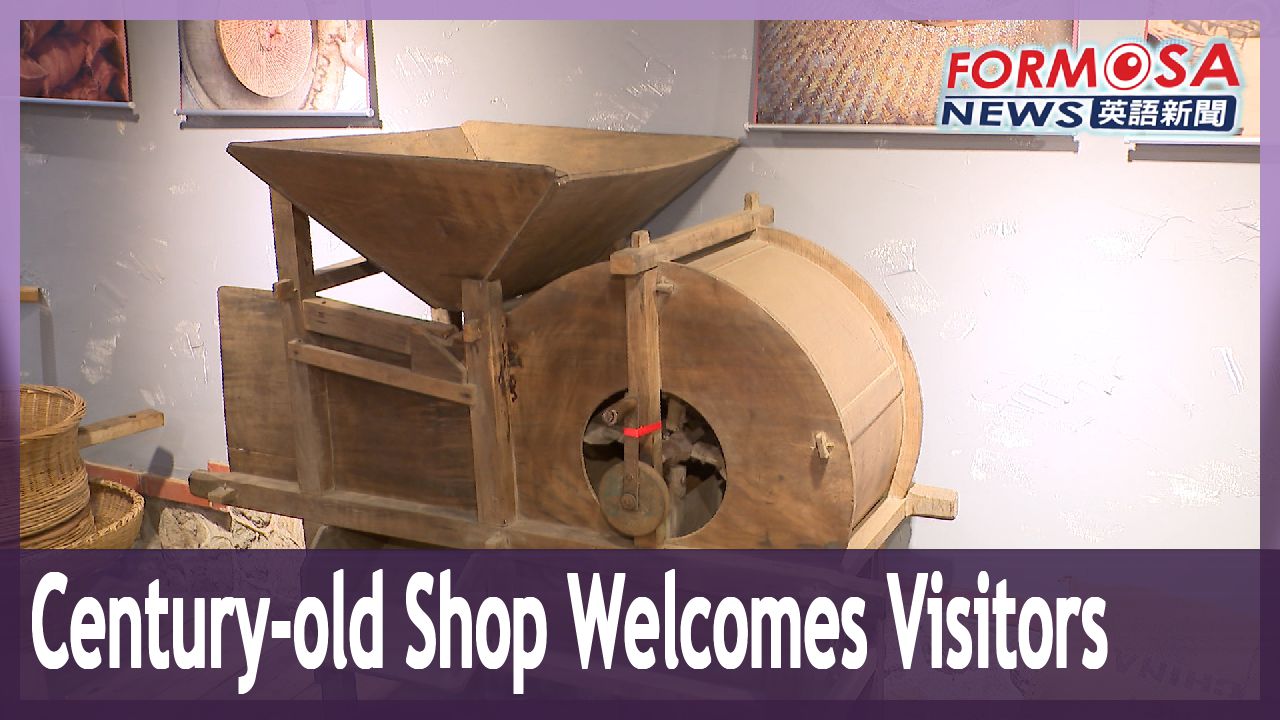
At first glance, it’s hard to believe this space is actually a century-old rice mill shop. In order to attract a new generation of visitors, the fifth-generation owner of the store, Yeh Yen-ting, partnered with a costume rental shop to allow patrons to rent qipaos and tour its historic shop. Visitors can learn about Taiwanese rice culture and rice farming. The shop is also holding exhibitions to help visitors understand its 100-year history.
Yeh Yen-ting
Shop owner
Why we need those kind of milling machines? Since 1923, in Dadaocheng, we purchased a lot of rice from the middle of Taiwan and south of Taiwan. They will use two types of transportation. One is railway and the other way is through the ships at Danshui river to Dadaocheng. The first process, they will do the drying all the rice grain. That is the first step. The second step after drying the rice grain, they will send to the rice milling factory. That is what they Yehjinfa Museum, the factory used to do those kind of business.
Shahad Huang
Costume rental owner
We are very happy to provide a modified Western-style qipao from the early years of the R.O.C. We also allow all visitors to experience the Japanese yukata experience. We want to provide the summer kimono experience because the history of Dadaocheng can be traced back to the Japanese colonial period. Many local cultural relics are preserved here.
In the past, the northern section of Dihua Street was an important town for selling rice and daily necessities in Taipei. The Sunrice Yehjinfa is a family-run rice mill that was founded by the Yeh family in 1923. In addition to being a rice milling shop, it was also the residence for the owners, as well as a traditional Chinese medicine store. Back then, more than 60 people lived here. The century-old rice mill shop is now run by the family’s fifth-generation owner Yeh Yen-ting and has been transformed into a museum. Yeh says, running the family business is not that easy.
Yeh Yen-ting
Shop owner
The difficulty is how we market this place. How we collect history material from the Yeh family. We do documentation research from libraries. Most important thing is how to run the museum like break even. We need to think about where the income comes from. Right now, we cooperate with a lot of schools. They do the education. We will also promote courses to teach everybody how to make rice.
Hoping to tell the story of rice milling factories in the early days of Taipei’s Dadaocheng area, Yeh hired designers to renovate the space, in a bid to draw in visitors. The architects designed wooden trusses that can stand on their own. The team is also constantly developing new innovative products to cater to its patrons, he said.
Yeh Yen-ting
Shop owner
We use rice material to produce some rice crackers. For the people, they will know how to make rice crackers. We try to do the education. Since in Dadaocheng, there are a lot of elementary schools or a lot of schools will come to this place and try to know the rice milling industry in Dadaocheng.
Stephany Yang
FTV reporter
Besides the rice tour, you can also come to the second floor and play on this self-playing piano that is 103 years old.
Yeh Yen-ting
Shop owner
The piano is one of a collection from a very famous American musical called the Wizard of Oz.
The Yeh family hopes that their historical space can be preserved and reused. They also hope to tell the stories of their ancestors so that everyone can learn more about the golden age of the rice trade in Dihua Street.
台北迪化街 百年米糧行華麗變身
2023-04-05
今天要帶大家去看看位在台北迪化街的百年米糧行。這間店建於1923年,目前由第五代經營,在進行了改造之後,現在成了屢獲殊榮的空間。為了吸引新顧客,米糧行與一家服裝出租店合作,讓遊客可以穿著古裝了解米糧業的歷史。
乍看之下,你可能很難相信這是一間擁有百年歷史的米糧行。為了拓展新客源,第五代經營者葉晏廷與一間服裝出租店合作,讓遊客可以穿上旗袍遊覽老店,了解台灣稻米文化和稻作。店裡也有展覽,幫助遊客了解米糧行的歷史。
[[老闆 葉晏廷]]
"為什麼我們需要那些碾米機器,因為1923年起,在大稻埕,我們大量收購台灣中南部的米。他們用兩種交通工具,一種是鐵路,另一種是透過從淡水河到大稻埕的船。第一個步驟,他們烘乾所有的米粒,第二步,米粒烘乾後就會送到碾米廠,那就是現在這個博物館以前所做的"
[[服裝出租店業者 黃予涵]]
"我們很開心,我們在這邊提供的是改良的西式的民國初期的旗袍。我們另外也可以讓所有遊客感受日本的浴衣體驗,我們提供浴衣是因為在最早的時候,大稻埕的歷史是可以追溯到日治時期的演變。這裡保留很多當地文物"
昔日,迪化街北段是台北米行及生活用品批發的重鎮。葉氏家族於1923年創立了「葉晉發商號」,除了經營輾米行,也是葉氏家族的居住空間,店口則是租給中藥行。當時,有60多人住在這裡。家族第五代葉晏廷接手後,轉型成博物館,葉晏廷表示,經營家族企業並不容易。
[[老闆 葉晏廷]]
"困難點在於我們如何推銷這個地方。我會收集葉家的歷史資料,我們從圖書館進行文獻研究。最重要的是如何讓博物館可以收支平衡,我們需要考慮收入從何而來。目前,我們跟很多學校合作進行教育活動,我們還將推廣課程,教大家如何製作米飯"
為了講述台北大稻埕地區早期輾米行的故事,葉晏廷請建築師翻新空間,以木造桁架做為新的空間意象,藉此吸引遊客。經營團隊也不斷開發創新產品,希望能滿足顧客的需求。
[[老闆 葉晏廷]]
"我們使用大米來生產米果,遊客可以了解如何製作米果。我們嘗試進行教育,因為在大稻埕,有很多小學,很多學校都會來這裡,想了解大稻埕的碾米產業。"
[[民視英語新聞記者 楊怡安]]
"除了透過導覽了解米文化,遊客還可以來到二樓,試試這台已經103歲的自動演奏鋼琴”
[[老闆 葉晏廷]]
"這架鋼琴是一部非常著名的美國音樂劇《綠野仙踪》的收藏品"
葉家希望保留及活化這個陪伴他們上百年的歷史空間,也希望透過講述先人的故事,讓更多人了解迪化街稻米貿易的黃金時代。
Related News