How to store medicines at home safely: pharmacists explain
Today we’ve got a masterclass in storing home medicine. Pharmacists say that lots of people store drugs in the wrong places, and for too long. For example, older adults may think the fridge is the best place to keep eye drops, but it can actually be the worst place. And how long can you keep a product before it goes bad? We spoke to two pharmacists to get the facts on these and other dilemmas.
A patient squeezes out some eye drops. They don’t want to waste the rest, so they put it in the fridge for safe keeping. But pharmacists say that’s the wrong move.
Su Po-ming
Pharmacist
Your typical eye drops can be stored at room temperature. If you put them in the fridge and take them out again, the crystals might not be able to melt back into their original liquid state, and when you put them in your eyes, they could damage the cornea.
The majority of medicines can be stored at room temperature in a cool place, unless your doctor or pharmacist specifically tells you to put it in the fridge. It’s best to avoid keeping drugs in kitchens, bathrooms, window sills and vehicles, as those places can cause medicines to go bad. But above all, avoid decanting a drug from one container to another.
Yi Li-chen
Pharmacist
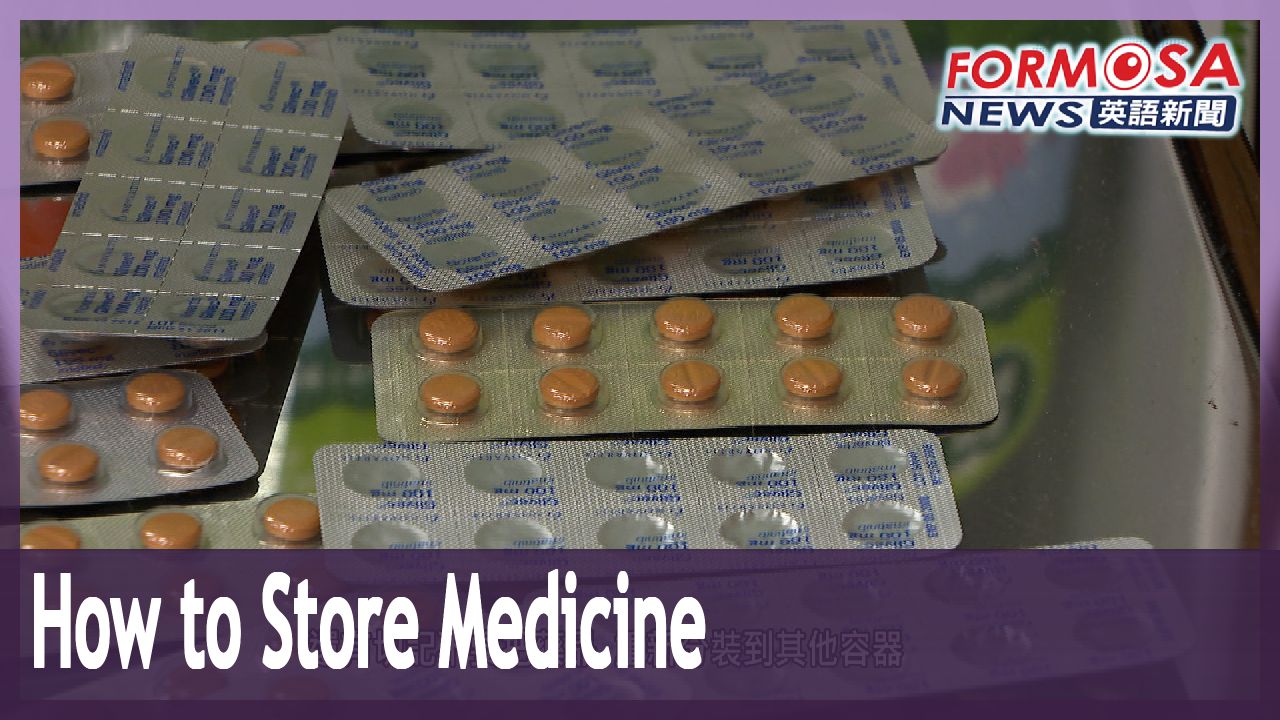
The principles of storage for medicines are, avoid light, humidity and heat. This bottle is opaque, to keep the medicine away from light. Some bottles contain a desiccant which you can see when you open it; that’s helping keep the product dry. If you put a medicine like this into a medicine dispenser, it immediately starts a chemical reaction with the water particles in the air, and it starts to become sticky.
Medicines that have been packaged in a pharmacy can usually not be kept for more than six months.
Yi Li-chen
Pharmacist
Things that are packed up like this can generally only be kept for three to six months - if you’re keeping it at normal room temperature or below, and the humidity is no higher than 60%. If, after three to six months, you start feeling suspicious, you can take it to a pharmacist to assess whether it has gone bad.
Pharmacists say that you only need to specially dispose of packaging for controlled substances, like injection solutions, antibiotics, anticancer drugs or hormone supplements. Other medicines can be simply thrown away in general trash.
2023-04-05