Beyond liquor: How sorghum is driving new industries in Kinmen
Kinmen was once synonymous with battlefields and sorghum liquor. But today the outlying county is famed for much more, including beef noodles and beef jerky. How did this transformation come about? The answer lies in sorghum. Kinmen’s use of sorghum has evolved over time, changing the local economy with it. Tonight in our Sunday special report, we explore modern-day Kinmen and its relationship with this versatile grain.
Along the streets of Kinmen County, small stores offer specialty products. Shopkeeper Fu Yang-hang hawks his goods with an expert air.
Voiceover of Fu Yang-hang
Kinmen specialty shop owner
Kinmen has lots of these essential oil products. They’re a specialty, they’re very famous. They ease rheumatoid arthritis and protect the muscles and bones. This is bamboo leaf-wrapped candy, which is wrapped in the leaves used for zongzi. It carries the fragrance of the leaf. We also have noodles that are made by hand and sundried. Our bestseller is usually beef jerky, followed by Kinmen kitchen knives. Another popular product is Kaoliang sorghum liquor.
The area of Kinmen is about 150 square kilometers, making it one of the smallest administrative districts in Taiwan. But its sandy soil and dry climate make it the perfect spot for growing sorghum.
Wen Shui-cheng
Kinmen farmers’ association head
Kinmen has a long history of growing sorghum. It might have begun in 1952. After the Kinmen Kaoliang Liquor Company was founded, the commander at the time, General Hu Lien, declared that a catty of sorghum could be exchanged for a catty of rice. Due to Kinmen natural conditions, rice doesn’t grow well here. So this exchange was used to encourage farmers to grow sorghum. That sorghum was used to make liquor.
Spanning production, distillation, packaging, transport, and sales, the liquor industry is a major creator of jobs in the area. Thanks to sorghum, liquor is Kinmen’s biggest enterprise. But over on Taiwan proper, sorghum has done even more.
Following the footsteps of farmer Kao Tsung-mao, we walk through fields of sorghum. We’re at Tuku Township in Yunlin County. Sorghum was planted here deliberately, because of the high-speed rail line nearby.
The farmland in this area is irrigated entirely by groundwater. That’s led to severe land subsidence.
Back in the day when rice was grown, it took a tremendous amount of groundwater to flood the fields after rice transplanting.
Kao Tsung-mao
Yunlin farmer
One fen of land required two hours of pumping water. This one plot took more than 20 hours. This plot took more than 10 hours.
The government feared that subsidence would get worse and affect the safety of the nearby high-speed rail. It began encouraging farmers to stop growing rice and switch to less water-hungry crops. That’s why the salt-tolerant, drought-resistant, and heat-hardy sorghum was chosen.
Su Mao-shiang
Agriculture and Food Agency deputy head
The thing about sorghum is that it adapts to its environment very well. Sorghum is even referred to as the camel of crops. It is especially resistant to drought, and it’s the best choice for drought-like conditions.
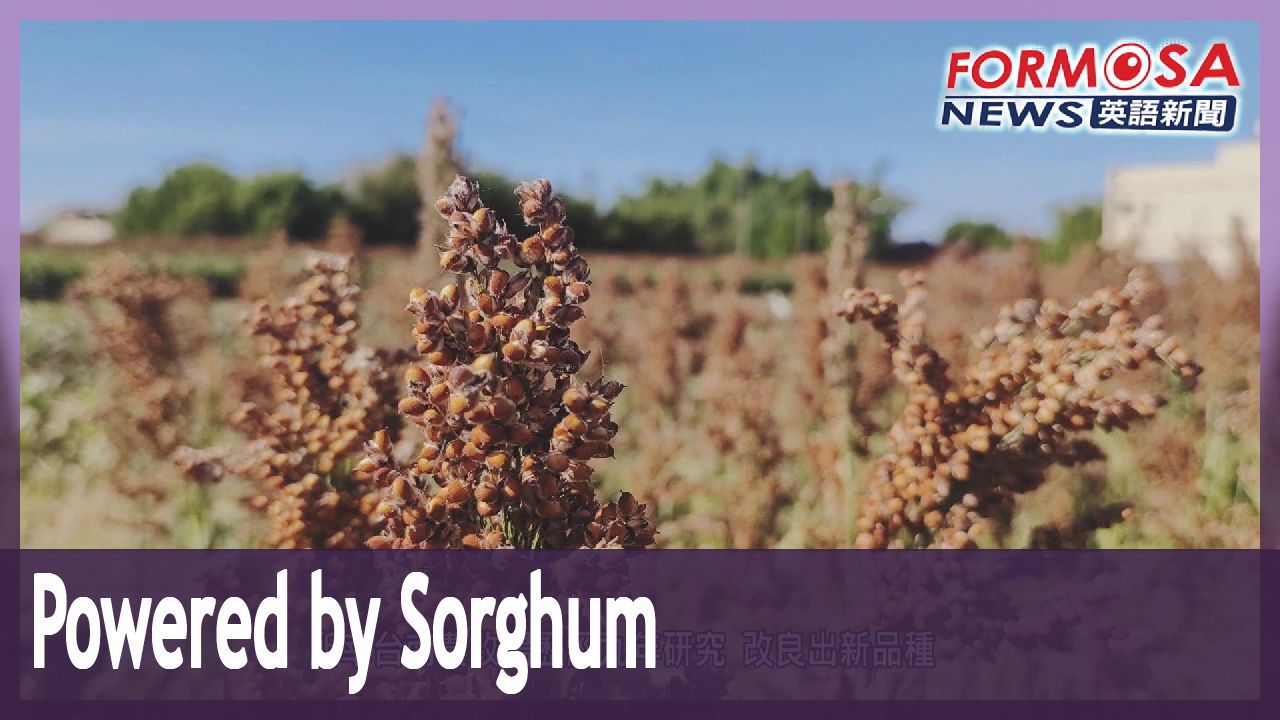
Although sorghum is highly drought resistant, its ears are densely packed and prone to mold after rain. That was enough to keep many farmers away. But after nine years of work, Tainan’s Agricultural Research and Extension Station developed a new variety of sorghum. This variety has scattered ears that dry more easily after rain.
With that, mold ceased to be a hurdle. Working with the government, Kinmen Kaoliang Liquor Company signed guaranteed purchase contracts with farmers on Taiwan proper, creating a big incentive to plant sorghum.
Ting Cheng-kang
Kinmen Kaoliang Liquor Company GM
These contracts started last year, and they are for a term of three years. We guarantee purchases. As long as the quality is sufficient, we guarantee that we’ll buy it. The price falls around NT$21 a kilogram. Actually, compared to other crops, sorghum takes less capital investment. This benefits the farmers’ bottom line.
Contracts have gone not just to farmers along the high-speed rail, but also to those in drought-stricken areas.
Farmers are contracted in Taoyuan’s Xinwu and Guanyin districts, which are designated as “water resource competition zones” by the government.
Chiang Hsieh-you
Taoyuan Guanyin farmers’ association head
All of Taoyuan, and especially Guanyin District, draws water from the Shihmen Reservoir for irrigation. Because the water in Shihmen Reservoir is needed for agricultural irrigation, industrial processes, and residential use, everyone is competing for water.
Su Mao-shiang
Agriculture and Food Agency deputy head
One hectare of rice needs 12,000 to 13,000 metric tons of water. But if I grow sorghum, I only need 1,200 to 1,300 metric tons, which is just one-tenth of the water needed for rice.
For the government, growing sorghum in Taiwan is way to slow subsidence and save water. For distilleries in Kinmen, Taiwanese sorghum is a high-quality product with a steady supply. It’s a winning proposition for all parties. But the process of making sorghum liquor also creates an environmental problem: distillers’ grains.
Inside the distillery, giant vats turn up above. The steam fills the air with the scent of sorghum.
Hsu Chien-yang
Kinmen distillery director
After the sorghum goes through the pipeline, it goes directly into the high-pressure, high-temperature cooking pot, which mainly removes residue, sterilizes, and gelatinizes it. After gelatinization, it is mixed with liquor yeast. After the liquor yeast is added, it’s cooled down. Then it goes into the temperature-controlled fermentation room for fermentation.
The process of making sorghum liquor takes 22 days. At the end of it, the sorghum that remains is called distillers grains. Kinmen distilleries produce up to 280 tons of this byproduct each day, generating a vast environmental footprint. The challenge is finding a sustainable way to deal with the waste.
Mr. Chang jumps off his truck and onto an excavator. He skillfully scoops distillers grains, filling the back of the truck. After a 20-minute drive, his truckful of grains arrives at the Kinmen Livestock Research Institute.
Lee Chin-ping
Kinmen Livestock Research Institute manager
As you all can see, the stock feed we use every day contains distillers’ grains. Distillers’ grains are sticky. They can stick to hay or to the clover pellets or wheat bran.
In 2011, the Kinmen Livestock Research Institute brought in Australian Brangus, a breed of beef cattle. Local farmers were encouraged to breed them to improve meat quality. Distillers’ grains were made available as free feed. That helped to build a thriving cattle industry in the area.
Wen Shui-cheng
Kinmen farmers’ association head
Cattle that eat distillers’ grain have a certain flavor – the meat contains certain amino acids that distinguish it from imported beef. We currently have 6,000 heads of cattle. That probably makes Kinmen the second largest beef producer in Taiwan, second to Pingtung.
Today, 70% to 80% of Kinmen’s cattle feed is free distillers’ grains. The free material saves farmers tens of millions of New Taiwan dollars in cattle feed. It’s also been a boon for the local restaurant sector.
A piping bowl of beef noodles, starring a Tomahawk steak. This is a new addition to Kinmen’s culinary scene, which is famous for beef raised on distillers’ grain.
The grains impart a sweet, delicate flavor to the meat.
Besides restaurants, there’s another sector that benefits from spent grains.
Hsueh Cheng-chen is on patrol at his beef jerky factory. He’s raised cattle and made jerky for three decades. Kinmen’s beef jerky is famous far and wide, and it’s a bestseller among tourists.
Hsueh Cheng-chen
Beef jerky factory owner
Whatever the cow eats, its body will have that fragrance, and its meat will have that flavor. Typical gamey flavors come from the feed. It’s a grassy flavor. Our cows here in Kinmen eat distillers’ grains, so there is no gaminess. If you’re especially sensitive, you might even be able to detect a whiff of liquor.
Local officials and distilleries have proactively promoted the beef industry. Raising cattle on spent grain has achieved more sustainable, eco-friendly liquor production.
Hsueh Cheng-chen
Beef jerky factory owner
Kinmen’s distillers’ grains give our beef jerky a special story, and that’s created the market demand. Our beef jerky and beef noodles are completely and independently traceable. We can look at a bag of beef jerky and know which cattle it came from and which farmer raised it. That’s all to protect our industry and protect our farmers.
Seventy years ago, Kinmen was synonymous with battlefields and liquor. But with its signature beef and water-saving grain contracts, Kinmen has added new chapters to its story.
For more Taiwan news, tune in:
Sun to Fri at 9:30 pm on Channel 152
Tue to Sat at 1 am on Channel 53
2023-09-24