Manufacturers give scrap materials a second life
In the world of manufacturing, scrap materials are a common byproduct. All too often, this waste ends up in the incinerator, racking up carbon emissions and expensive disposal fees. But times are changing. As the government pushes to go net-zero by 2050, more manufacturers are working to turn trash into treasure, to incorporate waste back into the production cycle. How are they doing it? Tonight in our Sunday special, we explore the ingenious world of recycling.
Dolls, ornaments, and tote bags. These are the creations of a craft workshop, and they look fine enough to sell. It’s hard to believe they were all made of this tangle of textiles.
Before class, the students must extract each piece of fabric from the pile and roll it into a neat ball.
It’s a hassle compared to using store-bought yarn, but this material is free of charge. The workshop uses it to support environmental sustainability. All of the fabric is waste from industrial processes.
Creator
We really make full use of this waste. We only have one Earth, and we must take good care of it.
This initiative to turn waste fabric into handicrafts came from a textile factory in Taoyuan’s Guanyin District.
Every month, the factory produces more than 200,000 kilograms of textile, and it dyes another 450,000 kilograms. In the process, it creates a mountain of scrap fabric – a headache for business owner Huang Kuo-peng.
Huang Kuo-peng
Textile factory head
Each roll has a head and a tail that we need to cut off. Say that each piece we cut measures 10 centimeters. That means making 400,000 kilograms of textile results in more than 4,000 kilograms of waste.
Fabric heads, tails, and swatches account for some 15,000 kilograms of waste every month. In the past, it was all sent to the incinerator, at a cost of NT$120,000.
Huang Kuo-peng
Textile factory head
Burning it cost us money, and it created carbon emissions. So we thought about how we could avoid the incinerator and turn the waste into something usable.
Huang was inspired by a TV show in which the characters did crochet around their community. He thought that his factory’s stretchy fabric was perfect for handicrafts. So he gathered up the waste and donated it to locals and nonprofits. To encourage people to use the fabrics, he started up a free craft workshop.
Huang Kuo-peng
Textile factory head
It’s that is what CSR everyone is talking about these days. I took the money I was spending on incineration and multiplied it by two. I used that to fund those activities, paying for the best teachers to come and teach. When students go home, they take back some materials they used in class. This way, we quickly deal with the waste materials.
Today, the craft workshop uses up 3,000 kilograms of fabric each month. But that’s only one-fifth of the waste produced by the factory.
Huang Kuo-peng
Textile factory head
We had the idea to make floor cushions. Because there is always lots of material left over: the heads and tails of each roll, and other cuttings. There’s still this much left, all of this is waste fabric.
Pieces that are too short or otherwise unsuited for crafts can still be good as stuffing for dolls and floor cushions. They can also be used in rooftop gardens, as a water-retention layer that saves water and reduces the system’s weight.
Scrap waste is also an issue for this sports equipment factory. Many years ago, it began finetuning its production system to achieve a “circular economy.”
A sheet of blue foam is fed into the machine, which cuts it into water kickboards. Then each kickboard is popped out by hand. The process leaves a great deal of foam unused.
In February 2024, the factory adopted an intelligent cutting machine with automated speed control. Computer software is used to create optimal product arrangements. The machine can cut foam without compressing it, significantly reducing waste.
Lu Tung-hung
Sports equipment factory manager
A stamping knife will compress the foam, deforming the edges. That forces you to use more of the material to account for the deformation. With a stamping knife, one sheet will yield between eight and 10 boards. But using this machine, you can make more than 10.
Besides reducing waste at the source, the factory also strives to make use of its leftover materials.
Leftover EVA and PE plastic are fed into a recycling machine, which splices it into small pieces. Then all air is forcibly expelled, shrinking each piece into a tiny granule similar to the original material. Over at this end, bits of leather are rolled into larger pieces in a machine. Together, these two recycling machines can handle more than 1 ton of waste every day.
Cheng Kun
Sports equipment business head
We manufacture and market water and outdoor sports equipment. If the environment is destroyed, there would be nowhere for people to go, and our products would be pointless. We are already able to recycle and reuse some of this waste, turning it into surfboards, yoga mats, yoga rollers, and other sports equipment.
But 90% of Taiwan’s businesses are small and medium-sized enterprises. Even with the best of intentions, few businesses can afford to recycle at scale. Nonprofits have been stepping in to buy waste, providing a way for small businesses to dispose sustainably.
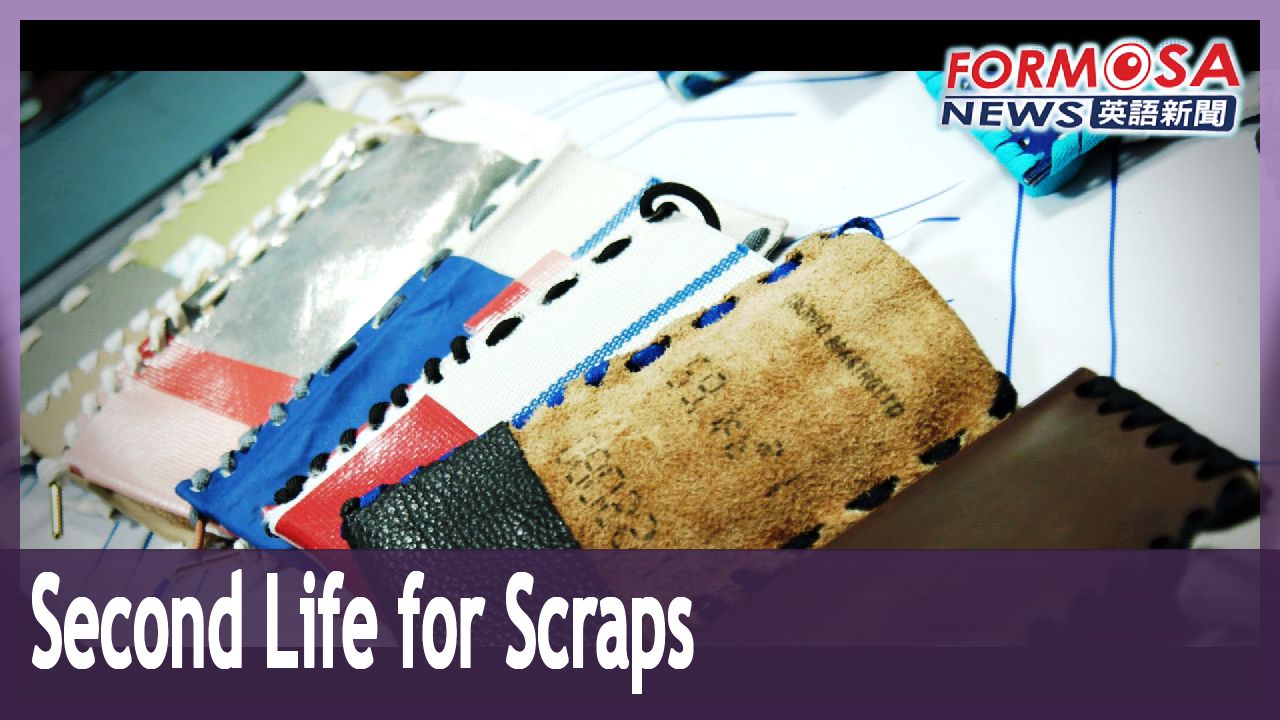
The pallets are covered with leather in a variety of colors and patterns. Most are leftover pieces from sampling. The pieces are too small to sell, but they’re perfect for the purposes of Lin Yu-chun and her partners.
Yeh I-ju
Instructor at sustainable design company
We take them and let our students turn them into products, such as water bottle carriers, smartphone pouches, and even backpacks, if the pieces are big enough. Backpacks like the one I’m using.
Lin’s sustainable design company specializes in eco-friendly bags and backpacks made of scrap materials. Instead of selling products directly, it runs workshops that teach people how to make them. This March, Lin was invited to return to her alma mater, National United University, to lead a workshop for juniors and seniors.
Armed with patterns, the students sift through a selection of leather scraps, seeking the right sizes and colors for their bucket bags.
Lin Yu-chun
Sustainable design company founder
In traditional industrial design, you design something and then you look for the materials to make it. We’re doing it the other way around. We’re starting with materials that are less valuable, materials that would otherwise end up in the garbage, and we’re seeing what we can make out of it.
But a single company can only process so much waste material. Lin believes that the key to sustainability is inspiring and teaching the public to recycle, through workshops like hers.
Lin Yu-chun
Sustainable design entrepreneur
We want people to see, “Hey, this is beautiful and new-looking material was about to be thrown out!” And we want to have them make something with their own hands, something they can use, something they will cherish ever the more. We hope that one day, we won’t need to run these workshops, because there will be no more scrap material.
In today’s consumer society, the goal of zero waste seems well out of reach. But every journey begins with the first step. If we can pause to consider the value of waste, before it reaches the incinerator, we open up possibilities for a more sustainable world.
For more Taiwan news, tune in:
Sun to Fri at 9:30 pm on Channel 152
Tue to Sat at 1 am on Channel 53
2024-07-07