Manufacturers give scrap materials a second life
Manufacturers give scrap materials a second life
2024-07-07
In the world of manufacturing, scrap materials are a common byproduct. All too often, this waste ends up in the incinerator, racking up carbon emissions and expensive disposal fees. But times are changing. As the government pushes to go net-zero by 2050, more manufacturers are working to turn trash into treasure, to incorporate waste back into the production cycle. How are they doing it? Tonight in our Sunday special, we explore the ingenious world of recycling.
Dolls, ornaments, and tote bags. These are the creations of a craft workshop, and they look fine enough to sell. It’s hard to believe they were all made of this tangle of textiles.
Before class, the students must extract each piece of fabric from the pile and roll it into a neat ball.
It’s a hassle compared to using store-bought yarn, but this material is free of charge. The workshop uses it to support environmental sustainability. All of the fabric is waste from industrial processes.
Creator
We really make full use of this waste. We only have one Earth, and we must take good care of it.
This initiative to turn waste fabric into handicrafts came from a textile factory in Taoyuan’s Guanyin District.
Every month, the factory produces more than 200,000 kilograms of textile, and it dyes another 450,000 kilograms. In the process, it creates a mountain of scrap fabric – a headache for business owner Huang Kuo-peng.
Huang Kuo-peng
Textile factory head
Each roll has a head and a tail that we need to cut off. Say that each piece we cut measures 10 centimeters. That means making 400,000 kilograms of textile results in more than 4,000 kilograms of waste.
Fabric heads, tails, and swatches account for some 15,000 kilograms of waste every month. In the past, it was all sent to the incinerator, at a cost of NT$120,000.
Huang Kuo-peng
Textile factory head
Burning it cost us money, and it created carbon emissions. So we thought about how we could avoid the incinerator and turn the waste into something usable.
Huang was inspired by a TV show in which the characters did crochet around their community. He thought that his factory’s stretchy fabric was perfect for handicrafts. So he gathered up the waste and donated it to locals and nonprofits. To encourage people to use the fabrics, he started up a free craft workshop.
Huang Kuo-peng
Textile factory head
It’s that is what CSR everyone is talking about these days. I took the money I was spending on incineration and multiplied it by two. I used that to fund those activities, paying for the best teachers to come and teach. When students go home, they take back some materials they used in class. This way, we quickly deal with the waste materials.
Today, the craft workshop uses up 3,000 kilograms of fabric each month. But that’s only one-fifth of the waste produced by the factory.
Huang Kuo-peng
Textile factory head
We had the idea to make floor cushions. Because there is always lots of material left over: the heads and tails of each roll, and other cuttings. There’s still this much left, all of this is waste fabric.
Pieces that are too short or otherwise unsuited for crafts can still be good as stuffing for dolls and floor cushions. They can also be used in rooftop gardens, as a water-retention layer that saves water and reduces the system’s weight.
Scrap waste is also an issue for this sports equipment factory. Many years ago, it began finetuning its production system to achieve a “circular economy.”
A sheet of blue foam is fed into the machine, which cuts it into water kickboards. Then each kickboard is popped out by hand. The process leaves a great deal of foam unused.
In February 2024, the factory adopted an intelligent cutting machine with automated speed control. Computer software is used to create optimal product arrangements. The machine can cut foam without compressing it, significantly reducing waste.
Lu Tung-hung
Sports equipment factory manager
A stamping knife will compress the foam, deforming the edges. That forces you to use more of the material to account for the deformation. With a stamping knife, one sheet will yield between eight and 10 boards. But using this machine, you can make more than 10.
Besides reducing waste at the source, the factory also strives to make use of its leftover materials.
Leftover EVA and PE plastic are fed into a recycling machine, which splices it into small pieces. Then all air is forcibly expelled, shrinking each piece into a tiny granule similar to the original material. Over at this end, bits of leather are rolled into larger pieces in a machine. Together, these two recycling machines can handle more than 1 ton of waste every day.
Cheng Kun
Sports equipment business head
We manufacture and market water and outdoor sports equipment. If the environment is destroyed, there would be nowhere for people to go, and our products would be pointless. We are already able to recycle and reuse some of this waste, turning it into surfboards, yoga mats, yoga rollers, and other sports equipment.
But 90% of Taiwan’s businesses are small and medium-sized enterprises. Even with the best of intentions, few businesses can afford to recycle at scale. Nonprofits have been stepping in to buy waste, providing a way for small businesses to dispose sustainably.
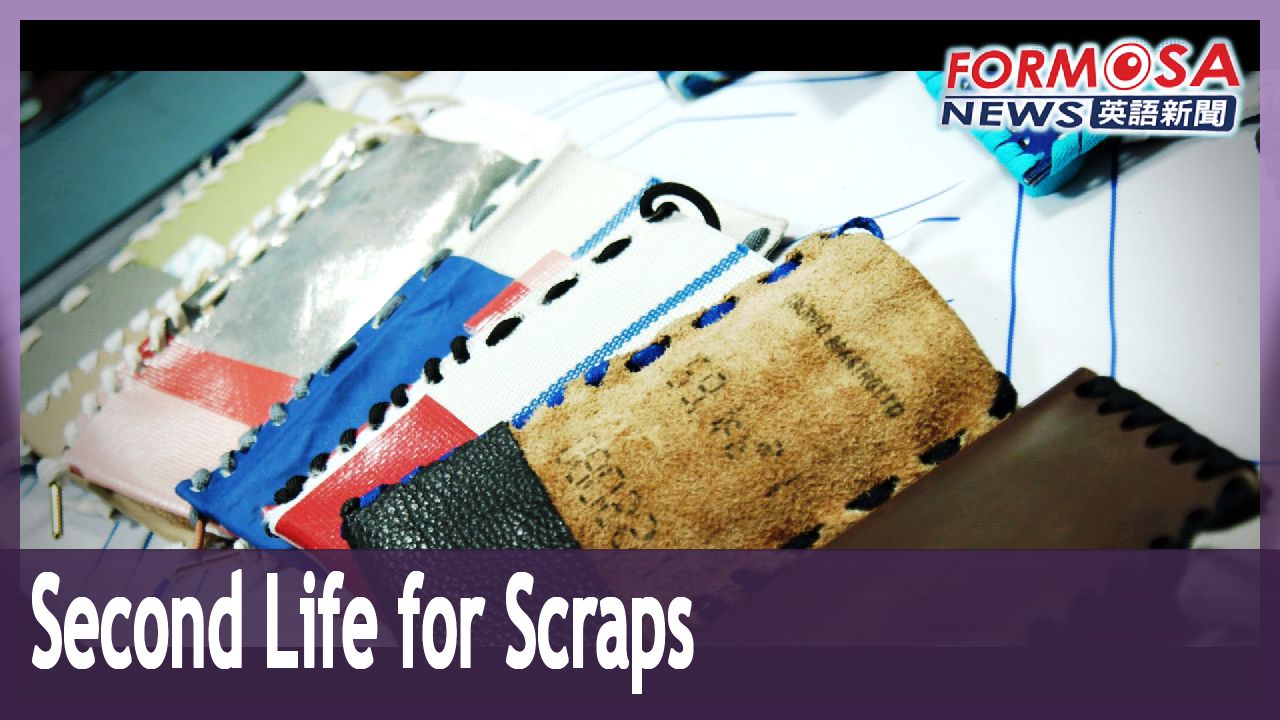
The pallets are covered with leather in a variety of colors and patterns. Most are leftover pieces from sampling. The pieces are too small to sell, but they’re perfect for the purposes of Lin Yu-chun and her partners.
Yeh I-ju
Instructor at sustainable design company
We take them and let our students turn them into products, such as water bottle carriers, smartphone pouches, and even backpacks, if the pieces are big enough. Backpacks like the one I’m using.
Lin’s sustainable design company specializes in eco-friendly bags and backpacks made of scrap materials. Instead of selling products directly, it runs workshops that teach people how to make them. This March, Lin was invited to return to her alma mater, National United University, to lead a workshop for juniors and seniors.
Armed with patterns, the students sift through a selection of leather scraps, seeking the right sizes and colors for their bucket bags.
Lin Yu-chun
Sustainable design company founder
In traditional industrial design, you design something and then you look for the materials to make it. We’re doing it the other way around. We’re starting with materials that are less valuable, materials that would otherwise end up in the garbage, and we’re seeing what we can make out of it.
But a single company can only process so much waste material. Lin believes that the key to sustainability is inspiring and teaching the public to recycle, through workshops like hers.
Lin Yu-chun
Sustainable design entrepreneur
We want people to see, “Hey, this is beautiful and new-looking material was about to be thrown out!” And we want to have them make something with their own hands, something they can use, something they will cherish ever the more. We hope that one day, we won’t need to run these workshops, because there will be no more scrap material.
In today’s consumer society, the goal of zero waste seems well out of reach. But every journey begins with the first step. If we can pause to consider the value of waste, before it reaches the incinerator, we open up possibilities for a more sustainable world.
For more Taiwan news, tune in:
Sun to Fri at 9:30 pm on Channel 152
Tue to Sat at 1 am on Channel 53
科技「回春」加上創意 邊角廢料也能變黃金!
2024-07-07
製造業在生產過程中,幾乎難以避免地會產生剩餘邊角料。過去,這些邊角料大多被當成事業廢棄物,送進焚化爐燒掉。對業者來說,不只是再花一筆高昂的處理費用,還會增加商品的碳排放量。為了呼應「2050淨零碳排」政策,也善盡社會企業責任,現在有許多本土廠商,開始試著利用這些邊角料。除了透過手工創意,把垃圾變黃金,還有企業將邊角料變成原料的一部分,再次加入生產流程,將資源的價值最大化。要怎麼做?繼續帶您了解。
玩偶、擺飾、手提袋,這些創意手編教室學員的作品,漂亮得像是可以販售,讓人很難相信,這些作品的原料,竟然是像這樣亂七八糟的廢布團。
從各式各樣的凌亂布條中,找出線頭,整理成一球球線團,是學員們每次上課前的重大工程。
用起來雖然不如市售的線材方便,但這些材料全都免費,背後更是學員們支持環保的理念,因為這些廢布團,其實都是紡織廠在裁切布料時,剩下來的邊角料、布邊條。
[[創意手編教室學員]]
“真的是完全廢物利用,我們只有一個地球,是真的要好好愛護它”
利用手編工藝,讓布邊條重獲新生的創意,就來自於桃園觀音的這間織染廠。
黃國彭董事長經營的織染廠,每個月織廠生產的布超過20萬公斤,染廠也有超過45萬公斤的產量,但隨之而來海量的廢棄邊角料,卻成了令黃國彭頭痛的問題。
[[本土紡織企業董事長 黃國彭]]
“每一支布的頭跟尾,都各有一段要裁掉,裁掉假設10公分就好,40萬公斤(的布),可能光這個就4000多公斤了”
用來銜接兩塊布的布頭,布尾、被切除的布邊條,還有被用來當樣品的碼布,加總起來,每個月產生的邊角料和廢布,就高達15000公斤,過去被當作事業廢棄物送到焚化爐,光是處理費用就高達台幣12萬元。
[[本土紡織企業董事長 黃國彭]]
“進去燒以後,我們除了要付錢以外,另外,它就是排碳,我如何可以不要讓它去燒,把它變成可以用的(材料)”
黃國彭董事長從電視劇中,主角們在社區內勾毛線的畫面得到靈感,聯想到紡織廠切下來的彈性布邊條,很適合作為編織材料,於是將布邊條統統蒐集起來,無償提供給社會大眾和公益團體自行取用,為了推廣這個觀念,還特地開設免費的創意手編教室,教民眾如何使用布邊條進行編織。
[[本土紡織企業董事長 黃國彭]]
“一方面現在都在談, 企業社會責任,我把要拿去燒的這筆錢,乘以二,作為活動的基金,我們花錢請最好的老師來教,當你要回家的時候,上課用的這些材料,自己再帶一包回家用,如果每一個人來這裡上課,都帶一包回去的話,我們很快就可以把這個部分處理掉”
現在創意手編教室,每個月可以消耗3000公斤的布邊條,但這樣的量,只佔織染廠每個月產生,廢棄邊角料的五分之一。
[[本土紡織企業董事長 黃國彭]]
“懶骨頭提出的概念就是,我們還有很多布頭,布尾的廢料,裁掉的廢料,這麼多,這都是廢布,都是廢布”
零散、長度不足的廢布,無法作為手編材料,但很適合當作玩偶、懶骨頭的填充材料,也可以被應用在建築物的空中花園,利用吸濕特性,作為底部的保水層,既能省水也可以減輕建築負重。
同樣面對邊角廢料問題,另一間,專營戶外運動用品的本土企業,則是從多年前,就開始投資改善生產流程,希望落實循環經濟理念。
員工手動放好藍色泡棉材,透過沖刀切割成浮板的形狀,再一片片手動槌下來,但仔細看這些切割完的泡棉板材,邊緣剩下來很多沒用到的材料。
2024年2月,工廠引進智能速控切割機,除了透過電腦,智慧化地排列產品形狀,也不必再壓扁泡棉板材,大大提升材料利用率。
[[戶外運動用品工廠廠長 呂東洪]]
“用沖刀的話它會被壓扁,壓扁之後它的邊緣就變形了,所以我就要用更大的原料防止它變形,像這個材料用沖刀的話 ,一床就只能做8個到10個(浮板),透過這樣裁切,我可以做到10幾個”
除了從源頭減少材料浪費,無法避免的剩餘邊角料,也有方法能夠再次利用。
廢棄的EVA及PE塑膠泡棉,透過輸送帶送入回收設備切成碎塊,再「消泡」擠出空氣,體積瞬間縮小,變成顆粒碎片,相當接近原材料的狀態,而零碎的皮革廢料,則透過旁邊的滾輪機器,重新鞣製成大片材料,兩台機器加起來,每天可以處理超過1公噸的邊角料。
[[戶外運動用品品牌董事長 程鯤]]
“我們生產或行銷的都是水上或是戶外用品,如果環境不好的話,什麼地方都不能去,有生產也沒有用。我們已經可以把這一些事業的邊角料,有部分能夠回收再利用,做成衝浪板,或者是瑜伽墊,瑜伽柱,或是一些其他的運動用品”
然而台灣的中小企業佔9成以上,即便有心,也未必有資金餘裕,做回收邊角料的「賠本生意」,民間團體主動上門收購,成為中小企業去化邊角料的管道之一。
棧板上的一塊塊皮革,顏色、花樣各有不同,大多都是皮革廠打樣時,剩下來的邊角料,雖然因為量太少無法製成商品販售,卻是林育君和夥伴眼中的絕佳素材。
[[永續設計公司講師 葉羿汝]]
“我們就是拿來讓學生去做成品,水壺袋、手機袋,甚至大一點的做背包,像是我這種背包,都可以”
林育君的永續設計公司主打使用邊角料,再製成環保袋或是背包等日常用品,所有商品都不直接販售,只開工作坊教民眾製作方式,3月下旬,他受邀回到母校,國立聯合大學的工業設計系,帶著大三,大四的學生,上了一堂手作課。
學生們拿著剪好的模板,在不同的皮革邊角料上比劃,努力在有限的材料中,找到適合的大小、顏色,創作屬於自己的水桶袋。
[[永續設計公司創辦人 林育君]]
“原本工業設計是說,我設計一個東西,我再去找材料把它做出來,我們是反過來,我們是看著那些,比較沒有價值的材料,擺著擺著就要丟掉的材料,我們來看看,它還可以做什麼”
但畢竟單靠一家小公司,能吸收的邊角料數量還是有限,林育君認為透過工作坊,讓民眾產生想要利用邊角料的想法,並學會利用的方法才是解方。
[[永續設計公司創辦人 林育君]]
“讓大家親眼去看到,怎麼會這麼漂亮,這麼新的材料,就要被丟掉,然後再透過他們雙手,去做出他們自己,可以使用的東西的時候,他們就會比較珍惜它,我們希望有一天,我們不需要,再開這種邊角料的工作坊,因為沒有邊角料了”
如今我們處在高消費社會,或許距離零邊角料,零廢棄的理想,還太遠,但若能在廢棄物被送進焚化爐之前,重新審視它們的價值,善用設計與創意,變廢為寶,已是目前我們能做到,最環保、愛地球的事。
更多新聞內容,請鎖定:
民視台灣台(152頻道)週日至週五晚上9:30
民視新聞台(53頻道)週二至週六凌晨1:00
Related News