Taiwanese snacks: sweet potato in the spotlight
Taiwanese snacks have a big reputation. They’re not just popular with locals - they’re a must-try for any tourist in Taiwan. The history of Taiwan’s snacks is inextricably linked with the country’s crops. For example, oyster omelettes, ba-wan meatballs, rice cakes are all made with sweet potatoes, which became popular in Taiwan due to rice shortages. Today we begin a three-part series on the evolution of Taiwanese snacks.
Steamed, boiled, fried, deep-fried: dozens of well-known street foods make up the taste of Taiwan we know and love.
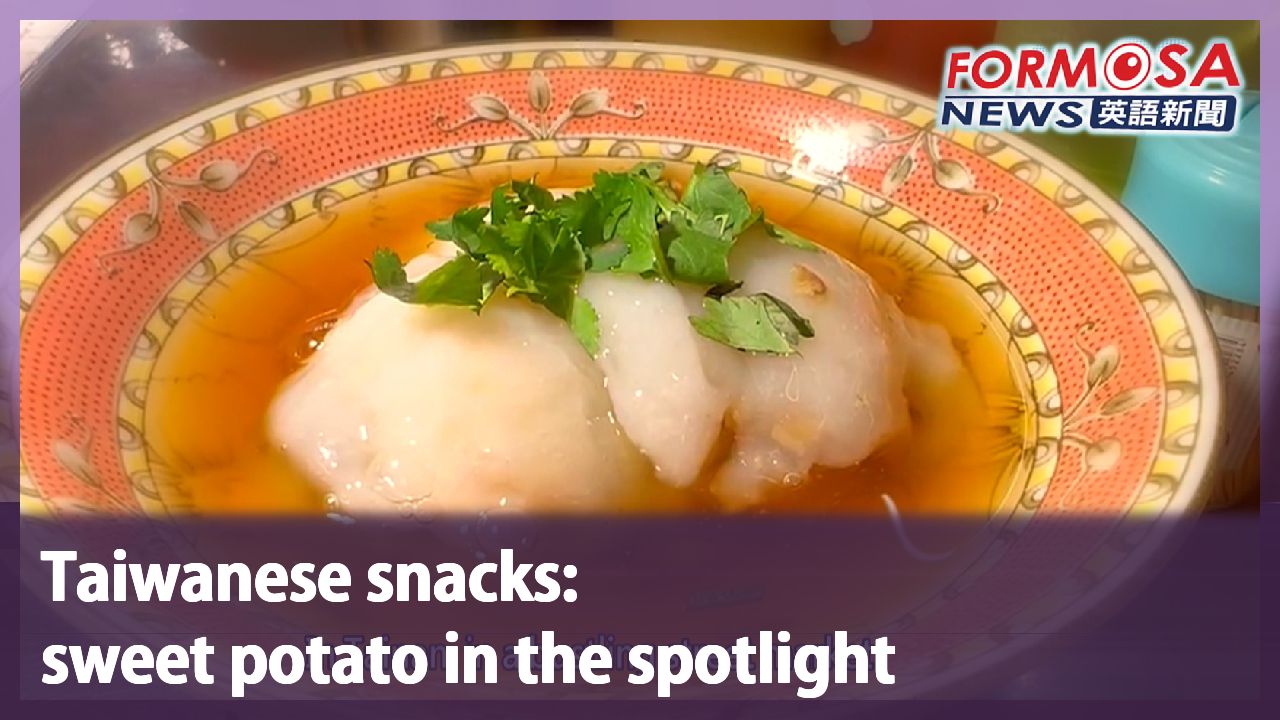
Milky white oysters sizzle on a teppanyaki grill. Egg is drizzled on, sometimes beansprouts, and then a special sauce thickened with cornstarch. A garnish of leaves, a flip, a final sizzle, and a delicious oyster pancake is served.
Ou Chien-chih
Third-generation oyster pancake expert, Anping
My grandma says that in the old days they were called “tsian-te.” They were made of simple, local ingredients: bean sprouts, vegetables, some sweet potato flour added in, mixed together and fried, into a pancake shape. Later, when they had oysters – because they produce oysters here in Anping – they added the oysters in, making the oyster pancakes we have today.
According to local legend in Tainan’s Anping, when Zheng Chenggong’s army landed here in 1661, making an attack on the Dutch colonists, the Chinese army ran out of rations.
Zheng’s army made a sauce with local ground sweet potatoes, to avoid starvation. They deep fried the batter with local foods, greens and meats, to make “tsian-te.” These cakes helped the army regain their strength, and win Fort Zeelandia from the Dutch.
Chen Ching-yi
Food writer
In the late Qing dynasty, they had foods like oyster pancakes. We see in the documents that on the coast of China’s Fujian and Guangdong provinces, they had those kinds of foods. But following migration, when they came to new places, these foods evolved.
But these ingredients are put together in very different ways, making their taste and appearance differ greatly from the Taiwanese oyster pancake.
Benson the Teacher
Food culture writer
In Chaoshan they make “oyster bakes,” which are really bakes. They mix the oysters, sweet potato powder, salt and chilis together, and bake them like a flat cake. More unusually, in Malaysia. They first make a cake, made of the batter and egg. Then they put that to one side, and stir-fry the oyster. Then they mix the cake and the oyster. And they eat it with chili sauce on top.
For Taiwanese oyster pancakes, the quality of the pancake hinges on this vital batter sitting in a bowl by the grill.
Ou Chien-chih
Third-generation oyster pancake expert, Anping
We make ours with pure sweet potato powder, with some simple seasonings. The water ratio is about 1:3. You go by experience. Of course you need the right heat level.
Sweet potato flour is a staple made of sweet potato starch that is used to thicken sauces. Sweet potatoes were more readily available than rice in Taiwan’s early agricultural society.
In 1603, Chinese Ming dynasty scholar Chen Di wrote in “Dong Fan Ji” that Taiwan had “onions, ginger, and sweet potatoes.” Sweet potatoes have been a staple in Taiwan since the 17th century. But sweet potatoes don’t keep long after harvesting.
In1921, Japanese writer Iwao Kataoka noted in the “Journal of Taiwanese Customs” that people would grind up sweet potato peelings, add water, and let it thicken and dry, to create a powder that kept for long periods.W
Chen Shu-hua
Author of “The History of Changhua Snacks”
In some villages, they would add lots of ingredients to the sweet potato powder, to make a food they considered very delicious. Even if they just added very simple pickled radish, they still thought it was delicious.
Sweet potato-based sauces have a different consistency from those made of the more traditional arrowroot. and even from potato starch, making sweet potato a good choice for the wrapping of many snacks. The search for the perfect “chewy” texture became a feature of Taiwanese snack culture.
Taiwanese meatballs – or “ba-wan.” Ba-wan boast shiny, translucent skin and springy, chewy texture, making them the quintessential sweet potato flour-based snack.
The chewy ba-wan skin is dipped in sweet sauce, or simply drizzled in thick soy sauce: a tempting aroma and a perfect bite.
The proportion of sweet potato to rice paste is the key factor in adjusting the texture of a ba-wan.
More sweet potato flour makes the ba-wan more translucent and chewy. That’s the ideal texture for Changhua’s traditional ba-wan makers.
Chen Shu-hua
Author of “The History of Changhua Snacks”
Later, the sweet potato was selectively bred, so people in Changhua City started to make ba-wan with lots of sweet potato and not add rice paste anymore. But outside of Changhua City, such as in Lukang, Yuanlin, elsewhere in Changhua County, or even farther north, they have rice in their ba-wan, and they add sweet potato to the rice.
Taiwanese ba-wan are cooked in two main styles: southern-style steamed, and northern-style deep-fried. Changhua northern-style deep-fried is more common.
Huang Wan-ling
Food writer
Steam them until they’re hot and separate. Put them in cold oil and warm it gently: not so hot that they form a skin. Gently fry them until they’re soft, and they’re done. Ba-wan have thick skins. They just have a little filling inside. But the filling is very aromatic, and its scent gets better the more you chew.
There are many types of ba-wan across Taiwan.
Changhua ba-wan are large, disk-shaped, and often filled with mushrooms or bamboo shoots, or sometimes even salted duck egg.
Beidou ba-wan are also filled with pork and bamboo shoots, but they’re triangular, just one hand big, and served in pairs.
Ba-wan from Puli, Nantou, are eaten in a special way. Locals like to start by eating the skin, leaving the filling and sauce in the bowl, then pouring on a big-bone broth to drink it as a soup.
In the south, in Tainan, Kaohsiung and Pingtung, it’s all about the ba-wan steamed in clear broth. Taiwan has developed many different types of ba-wan, but which one was the first?
Fan Chen-sen
Fourth-generation ba-wan expert, Beidou
How can we spot a Beidou ba-wan? It should have a mark on the back, like three fingers. And the bottom of it should look something like a map of Taiwan. That makes it an authentic Beidou ba-wan.
Beidou ba-wan are wrapped by hand, which results in three “marks” that indicate the authentic Beidou ba-wan. This technique is an old Fan family tradition.
Chen Shu-hua
Author of “The History of Changhua Snacks”
It was written in 1930. That means, before Mr. Fan, people were already selling ba-wan on shoulder poles. So I can say for sure that by the 1930s roast ba-wan were being sold in Changhua City. They were using the word “ba-wan.”
When Changhua’s ba-wan were first recorded in written documents, the Fan family’s Beidou ba-wan were being called “fen-wan.”
They contained fillings like dried pickled radish, until World War II ended in 1945, when the Fans began putting pork in their “fen-wan,” marking the birth of what we call “Beidou ba-wan.”
Wang Hao-yi
Cultural historian
Beidou ba-wan and Changhua ba-wan have one important difference. In Beidou they still make ba-wan by hand. They form the balls, put them in the steamer, set the shape, and then deep-fry them. Normally, in Changhua, and smaller towns under its influence, they use a mold for ba-wan, to press them into a disk shape.
Ten catties of arabica rice are stirred in this bucket, to create a thick sauce. Unlike in Changhua, where chewiness is king, The makers of southern clear-broth steamed ba-wan prefer a higher proportion of arabica rice in their ba-wan skins.
Chen Feng-chiu
Second-generation steamed ba-wan expert
Bamboo steam baskets keep the moisture better. If you use metal baskets, the steam escapes very fast. When the steam is gone, the ba-wan won’t be so wet and juicy. They won’t be so good, they’ll be a bit dry. Our ba-wan are not like the fried ones. They get deep-fried after the steaming, but ours do not. If we don’t hold onto the steam, the ba-wan will be too dry and not good.
Ba-wan differ in cooking techniques. And cooks have also brought a lot of creativity to the taste of their ba-wan, using lots of varied local ingredients.
In Hsinchu, the Hakka town of Beipu produced a special using traditional Hakka flavors: ba-wan with lees and pork.
In the ba-wan stores of Miaoli, one finds Hakka ba-wan with dried bean curd.
In Tainan, in a bustling street market once known as Sakariba, founded in the Japanese era, they invented clear-steamed shrimp ba-wan.
At this well-established store in Pingtung, the skin contains burdock, a flavor from Guilai, the homeland of the store owner’s wife.
Chen Feng-chiu
Second-generation steamed ba-wan expert
Then, one day one of the kids wrote in a school essay, “What are the specialties of Guilai?” He wrote, “Guilai specialties are burdock and ba-wan.” I thought, “Huh, it’s not a bad idea!” even if it does come from a school essay. So I put the burdock and ba-wan together.
Hundreds of years ago, to stave off famine, people first started grinding up sweet potato into a powder. What was once just a way to fill the stomach changed with Taiwan’s economic growth, gradually picking up lots of local twists, to become one of modern Taiwan’s favorite dishes.
Join us next week, as we look at how Chinese immigration shaped the evolution of Taiwanese snacks.
For more Taiwan news, tune in:
Sun to Fri at 9:30 pm on Channel 152
Tue to Sat at 1 am on Channel 53
2024-09-01