Taiwanese Snacks: the splendor of rice-based snacks
Taiwanese Snacks: the splendor of rice-based snacks
2024-09-15
Today we conclude our three-part series on Taiwanese snacks. Rice is a staple crop in Taiwan, so it’s no wonder that Taiwan has a cornucopia of rice-based snacks. You probably know of rice noodles, rice cakes, and glutinous rice zongzi dumplings. Rice noodles, whether fried or served in soup, are an absolute staple at every night market. In this third and final segment, let’s dig into the history of rice-based snacks.
Rice is Taiwan’s main staple, and is used in lots of rice-based snacks: glutinous rice cakes, sausage with sticky rice, puffed rice cakes, rice noodles, silver needle noodles – these small eats are endlessly tempting.
A bowl of chewy fried rice noodles is an important part of many housewives’ repertoire.
But while the recipe may look simple, mastering it is anything but.
When most people are sound asleep at 3 a.m., this rice noodle factory of 100 years’ standing is just gearing up to start another day.
This Indica rice has been soaking overnight. It’s ground into an aromatic paste.
The pure rice paste goes into cloth bags, and is pressed slowly with heavy wooden planks and jacks, to get out all the water.
Cakes of dough are cooked at high temperatures, then stirred – a lot.
“Whirling” the rice is the secret step behind the chewiness of rice noodles.
Lin Mei-chin
Third-generation rice flour noodle store owner, Hsinchu
You cook the dough to 40%, so it’s sticky. The chewiness comes from the mixture of cooked and uncooked rice. You mix it two or three times to solidify it, so the noodles don’t break easily.
After being “whirled” and pressed, the dough is rolled into cylinders, and dropped in the noodle extruder. Finally, a thousand strings of noodles emerge.
In Changhua’s Fenyuan, Nantou’s Puli, and Miaoli’s Jianshan, they’re boiled in the old style to produce thick noodles.
But in Hsinchu, they go into a steaming basket and come out as thin noodles.
Kuo Lien-chin
Third-generation rice flour noodle store owner, Hsinchu
They’re pressed and boiled, then dried out. We call them “water noodles,” pre-shrunk. Whereas “cooked noodles” are pressed and then steamed in a basket. We say “cook” to mean steaming in Taiwanese. So they’re “cooked noodles.”
Hsinchu rice noodles are steamed in high temperatures, and must then be beaten quickly, folded and cut, all at high speeds.
By dawn, the noodles must be laid out on bamboo racks for the final stage: drying in the sun and wind.
Hsinchu is known as the Windy City. It’s the perfect place to dry out rice noodles: 30% dried by the sun, 70% dried by the wind.
Tseng Ming-yao
Rice flour noodle factory CEO
We have to see the wind direction. If it’s a north wind today, say the north wind is coming from over here, then we lay the noodles like this. The sun shines on the top layer of noodles. For the bottom layer, we let the wind blow away the moisture. But there’s hundreds of noodles tangled together. The ones in the middle don’t get the sunlight. So we have to keep spreading them out – every hour we have to spread out more.
Rice noodle makers began to appear along the banks of Hsinchu’s Keya Creek in the Japanese colonial period, gaining this area the nickname “rice noodle town.”
Lin Mei-chin
Third-generation rice flour noodle store owner, Hsinchu
In the past, to make rice noodles, you had to get up early, before dawn, and go to the river to fetch water, then make a wood fire – there was no gas. So people used to say, “Don’t make a pigsty with good timber. Girl, don’t marry into rice noodle town. Weed properly to make good rice noodles” – because you have to cut the weeds, where you dry the noodles, to use them for firewood. The saying continues: “Lift up the pole as your tears fall. Girl, don’t marry into rice noodle town, you’ll soon be dead or wasting away.”
Before industrialization, they were a high quality food, a luxury, used only for temple offerings or banquets.
Tseng Ming-yao
Rice flour noodle factory CEO
In the agricultural era, before the ’60s, people were all eating sweet potato leaves,
rice was a rare thing. And if you made it into rice noodles, it was even higher class.
You could turn eight catties of rice into five catties of rice noodles. So it was a very precious thing. Also, because it’s these very long, thin, strings, it makes people think of longevity, something going on and on forever. It was used at Lunar New Year and Ghost Festival, when praying or making offerings to ancestors.
As the economy changed, this once luxury item became an everyday food. How it’s cooked is always changing. Rice noodles can be stir-fried, served in soup, made with pumpkin, taro or squid, and dry-fried or boiled in soup.
Huang Wan-ling
Food writer
The special thing about rice noodles is you must take care with the water content. “Rice noodle stir-fry” is not “fried rice noodles.” To “fry rice noodles,” first fry your other ingredients separately, then toss the noodles in broth, and finally mix the other things in. But to make “rice noodle stir-fry,” first flash-fry shallots in soy sauce. Then toss in the noodles, heap them up, add some braised pork sauce, mix it with bean sprouts – and that’s “rice noodle stir-fry.”
Rice noodles easily break during cooking. So manufacturers started adding cornstarch, or potato starch, to reduce costs and make the noodles stronger.
Chen Ming-fen
China Grain Products Research and Development Institute
They started using cheaper starches, to reduce breakage and improve the texture. So everyone started using starch to replace some of the rice. The biggest difference from rice is the starch has no protein at all. When you add it to the rice noodles, they get chewier, tougher, stronger, of course.
Starch-added rice noodles have bite, but pure rice noodles are floppy. Different textures, different cooking methods.
Chen Ming-fen
China Grain Products Research and Development Institute
To cook starch-added rice noodles, generally you boil them in water until soft, for a long time, 10 or 12 minutes, only take them out when they’re obviously soft. Pure rice noodles are different. They don’t need that. You just briefly dip them in the water. If you boil them too long, they’ll break when you fry them, or even in the water.
Rice noodles are chewy and filling. Another filling rice product is zongzi dumplings, which are made primarily of glutinous rice.
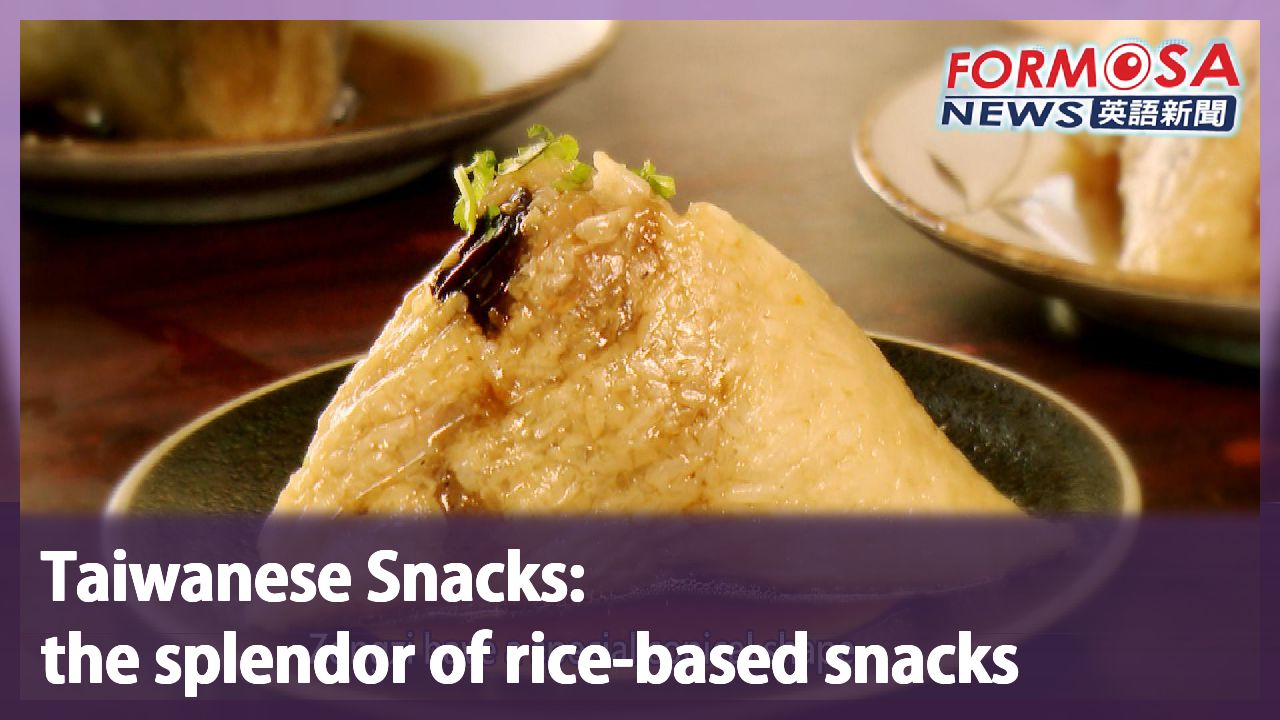
Zongzi have a special conical shape. Cut them open and they’re full of filling. The leaf wrapper infuses the rice with flavor. Zongzi are a delight to the eyes and the tastebuds. But making zongzi is a lot of work.
Stir-fried mushrooms are doused in pork broth. Meanwhile, premium pork is being prepared. There are many zongzi fillings, varying by region and personal taste. Southerners like peanuts; northerners like shrimps.
Other choices include pork belly, chestnuts, and of course, the star: a salted egg yolk. In the south, they use raw long-grain glutinous rice.
In the north, they season the glutinous rice, and steam-fry it half cooked.
Preparing the zongzi is hard enough, but wrapping it tight is the real test of the chef’s skill.
Wu Kuan-ting
Fifth-generation zongzi expert, Tainan
Makino bamboo wraps better. Sweet bamboo has a nicer flavor. First you fold it, then put the rice in, mushrooms, braised pork, cherry shrimps, lean meat, scallops, egg yolk, chestnuts. Finally some rice on top, mushrooms on top. Then you can close it, wrap it up.
You must leave the rice space to expand as it cooks. It can’t be wrapped too tight or too loose.
Wu Li-yuan
Fourth-generation zongzi expert, Tainan
If it’s too tight it will explode. Too loose doesn’t work either, it will leak. Some people like our zongzi. But in the end, mom’s zongzi are the best. Mom’s zongzi taste the best.
The wrapped zongzi are boiled in the south, but steamed in the north.
Overall, northern-style zongzi have a rich aroma, and each grain of rice is distinct. Southern-style zongzi are more soft and sticky. Both styles have their proponents.
Huang Wan-ling
Food writer
The northern zongzi are steamed. The rice was cooked first, it’s fixed with steam. The southern style is more difficult to make. If you wrap them too tight, they won’t cook. You can’t say one tastes better than the other. Whatever you prefer is the best. We can respect each other’s differences. No need to argue who’s No. 1!
There are many different types of zongzi. Longer zongzi originate from Chaozhou, China. Hunan zongzi have a simpler, pork-heavy filling.
Hakka zongzi fillings include pickled radish. “Alkaline zongzi” are transparent and sweet. White ginger lily zongzi taste like the flower. Local rice paired with local ingredients has led to many different flavors in different regions.
After WWII, braised pork zongzi were commonly sold by street hawkers: a nostalgic scene from pre-industrial society.
“Wrapping zongzi” sounds like “guaranteed win.” So that makes zongzi a very lucky omen for elections, or students taking exams.
Wu Mei-lan
Traditional zongzi store owner
Parents ask us to put in special fillings. But you can’t put the salted duck egg in if you want the kid to succeed. In the old days, information wasn’t so widespread. If a newspaper said, “Its going to rain blood!” “You must eat zongzi to clear the bad luck!” And then you took out a cart of zongzi, they’d sell out instantly.
Taiwanese snacks comprise the laborious zongzi and the simple danzai noodles; ba-wan, found only in Taiwan; oyster pancakes, made differently in many countries; and many other appetizing dishes.
They’re not just for the tastebuds, nor simply a vehicle for local culture. They also carry culinary memories linking us to meals in ages gone by.
For more Taiwan news, tune in:
Sun to Fri at 9:30 pm on Channel 152
Tue to Sat at 1 am on Channel 53
台灣米食小吃的典故 從高檔食材變庶民美食
2024-09-15
台灣盛產米,所以米食類的點心更是琳瑯滿目。大家熟知的有,米粉、碗粿、肉粽等等,有趣的是,台灣面積不大,單一美食卻能夠發展出不同的口味。至於米粉、炒米粉、米粉湯,可以說是各大夜市的基本款,尤其新竹米粉,是名聞遐邇。繼續這個單元一起來欣賞,米食小吃的典故。
稻米是台灣的主食,自然也衍生出不少米製的小點心,米糕、米腸、米香、米粉、米苔目,各類美食糕點,再再誘惑著所有人的味蕾。
口感極富嚼勁的炒米粉,是許多家庭主婦拿手的家常料理。
只不過,這看似簡單的米粉原料,其實製作過程,一點都不簡單。
凌晨三四點,大家還在睡夢中,百年老店的米粉廠,堅持現做,開始忙碌的一天。
浸泡整夜的在來米,研磨成香濃的米漿。
接著,百分之百純濃米漿,注入布袋中,再利用厚重的木頭、千斤頂,慢慢壓乾,脫水。
型塑成的粿糰經過高溫炊蒸之後,必須經過一次又一次不停地攪拌。
「掄粿」的過程,正是米粉Q彈的關鍵祕訣。
[[新竹百年米粉第三代媳婦 林美津]]
“做粿糰要蒸四分熟才有黏性,它的Q度是靠熟的跟生的去攪拌,攪拌兩三次,給它更紮實,米粉比較不容易斷。”
經過轆掄碾壓後的粿糰,捲成圓筒狀,再放進米粉車的銅斗裡,最後「千絲萬縷」的米粉,緩緩落下。
彰化芬園、南投埔里、苗栗尖山,遵循古法,投入大灶中水煮,屬於粗米粉。
至於新竹,則是進入蒸籠「蒸」,屬於細米粉。
[[新竹百年米粉第三代 郭連進]]
“擠壓下來後,在水中煮熟,再撈起來曬乾,這叫水粉,過水嘛! 至於炊粉,擠壓下來後,放進蒸籠蒸,在蒸籠裡面炊,台語稱「炊(蒸)」,就是炊粉。”
新竹米粉,經過蒸籠的高溫洗禮之後,必須快速拍打、拆絲、裁切,動作迅速。
因為必須趕在天亮之際,將米粉平整舖在竹篾上,進行最後一道手續,風吹,日曬。
被稱為「風城」的新竹,特別適合米粉,需要三分日曬,七分風乾的製程。
[[百年米粉廠總裁 曾銘耀]]
“我們要看風從哪個方向,如果今天是北風,我們假設北風從這邊過來,我們的米粉就要弄成這樣。太陽在照射的時候是照到上面,上面的表層,下面就是要靠風把水氣帶走,米粉是好幾百條交疊在一起,中間的,太陽曬不到就不會乾了,我們就要把它剝開,每一個小時都要來鬆一次。”
從日治時期開始,新竹客雅溪畔就陸續出現,許多製作米粉的人家,因此這裡也被稱為「米粉寮」。
[[新竹百年米粉第三代媳婦 林美津]]
“以前製作米粉,一大早就要起來,凌晨,以前都要去溪裡挑水,燒柴,沒有瓦斯。所以才流傳一句話,好材不做豬寮樑,阿娘不嫁米粉寮,米粉做好就除草。因為曬米粉的地方,雜草要割一割,回來升火,尖擔提起目屎流,阿娘不嫁米粉庄,不死也黃酸。”
在農業時代可是高級食材,只有拜拜或宴客,才看得到這道美食佳餚。
[[百年米粉廠總裁 曾銘耀]]
“六、七十年前,農業時代,那時候大家都吃地瓜葉的時代,米算是非常稀缺的東西,你要把它做成米粉,它又更高級了。所以它是很珍貴的東西,再加上它是一條一條的,會給人家長壽的感覺,綿延不絕的感覺。農曆年、中元節拜拜的時候,拜祖先、祭祖都會用到。”
隨著經濟成長,農業時代的高檔食材,如今成為平民美食,料理方式更是推陳出新,炒米粉、米粉湯、南瓜米粉、芋頭米粉、中卷米粉、乾炒、煮湯,兩相宜。
[[美食作家 黃婉玲]]
“其實米粉的特色,要注重水份,米粉炒跟炒米粉是兩種不同烹調,炒米粉是配料炒好後,放一旁。利用湯汁拌炒米粉,最後再將配料拌入,米粉炒是將油爆香紅蔥頭。再拌米粉,堆成山,再加點肉臊汁,放豆芽菜、肉臊汁拌一拌,這是米粉炒。”
由於米粉烹調過程容易斷裂。於是,開始有廠商試著加入,玉米澱粉或馬鈴薯粉,不但降低成本也更耐烹煮。
[[中華榖類食品工業技術研究所研究員 陳明芬]]
“後來就改成用比較便宜的澱粉,它比較不會斷,口感上會比較有改善。所以大家就開始用澱粉,去取代米穀粉。其實它跟米最大的差異是,它完全沒有蛋白質,以調合米粉絲來講,它當然是相當Q彈、耐煮、耐炒。”
調合式米粉有嚼勁,純米粉吃起來鬆軟,口感不同,烹調方式也有差異。
[[中華榖類食品工業技術研究所研究員 陳明芬]]
“調合米粉的做法,大部份是把米粉泡在水裡,泡軟,泡很久,大概泡個十分、二十分鐘,確定它軟了,就開始下鍋。純米的米粉不一樣,它不需要這樣泡,只要用水沖過一下,就要撈起來,如果泡太久,進到鍋子裡面炒,或是煮的時候,更容易斷。”
米粉口感Q彈,又具有飽足感,而同樣能夠滿足口腹之慾的,還有以米為主體的肉粽。
特殊的立體錐形,剝開來,滿滿的餡料。伴著融入粽葉香的糯米,能同時滿足視覺與味覺享受。只不過肉粽的製作過程,非常費工。
翻炒香菇,滷上一鍋肉臊,同時備好上等豬肉,餡料五花八門,依地區、喜好而有不同,南部偏好花生,北部則多用蝦米。
另外像是五花肉、栗子,當然少不了靈魂角色–鹹蛋黃。特別的是,南部採用的是,生的長糯米。
北部則是將糯米調味,蒸炒到半熟的程度。
備料辛苦,但接下來的綁肉粽,才是真正考驗手工技巧。
[[台南百年肉粽第五代 吳冠廷]]
“桂竹是包覆性比較好,麻竹是香氣比較好。所以先折一個弧度,放米、香菇、肉臊、櫻花蝦、瘦肉、干貝、蛋黃、栗子舖上來。最後再把米舖上來、香菇舖上來,就可以把它合起來,要把它包覆好。”
綁粽必須預留糯米熟透膨脹的空間。不能太鬆也不能太緊。
[[台南百年肉粽第四代 吳立源]]
“如果太大力會爆粽。太小也不行,會漏粽。有的人喜歡我們的粽。說來說去,最喜歡媽媽的粽。媽媽的粽最好吃。”
綁好的粽子,南部放入水煮,北部則用蒸籠炊蒸。
整體而言,北部粽香氣濃郁、粒粒分明,而南部粽口感明顯軟黏,南北風味大不同,卻能各領風騷。
[[美食作家 黃婉玲]]
“北部是用蒸的,米是熟的,用蒸的定型。南部粽困難度較高,因為綁完,太緊就難熟。口味不能說誰贏,有人愛吃就是好粽。口味不同,相互尊重,不必爭第一。”
事實上,粽子種類五花八門。有長條形的,源自中國潮州的潮州粽。也有餡料精簡,側重豬肉塊的湖南粽。
另外,還有內餡摻有菜脯的客家粽,晶瑩剔透、甜甜口味的鹼粽,將野薑花入味的野薑花粽,在地的米,搭配在地食材,形塑出屬於各地不同風味的粽子。
二戰後,燒肉粽,成為沿街叫賣的小生意,是農業時代的獨特風景。
由於包粽–諧音「包中」,也讓粽子成為選舉場合,或學子求考運時,充滿吉祥意涵的好采頭。
[[北部老字號肉粽老闆娘 吳美蘭]]
“家長要求我們包特製肉粽,但是裡面不能放鹹鴨蛋。因為要讓小孩包粽(中)。像以前的人資訊沒那麼發達,如果隨便新聞報導天要下紅雨,要吃肉粽,袪除不好的運。攤車一推出去,肉粽一推出去就馬上沒有了。”
台灣小吃,無論是工序繁瑣的肉粽,還是調理簡單的擔仔麵,也無論是台灣獨有的肉圓,抑或各國不同烹調方式的蚵仔煎,各種強調色香味俱全的小吃,
不只滿足個人的味蕾,展現在地的美食風華,更承載著每個時代,獨一無二的味覺記憶。
更多新聞內容,請鎖定:
民視台灣台(152頻道)週日至週五晚上9:30
民視新聞台(53頻道)週二至週六凌晨1:00
Related News