Taiwanese Snacks: the splendor of rice-based snacks
Today we conclude our three-part series on Taiwanese snacks. Rice is a staple crop in Taiwan, so it’s no wonder that Taiwan has a cornucopia of rice-based snacks. You probably know of rice noodles, rice cakes, and glutinous rice zongzi dumplings. Rice noodles, whether fried or served in soup, are an absolute staple at every night market. In this third and final segment, let’s dig into the history of rice-based snacks.
Rice is Taiwan’s main staple, and is used in lots of rice-based snacks: glutinous rice cakes, sausage with sticky rice, puffed rice cakes, rice noodles, silver needle noodles – these small eats are endlessly tempting.
A bowl of chewy fried rice noodles is an important part of many housewives’ repertoire.
But while the recipe may look simple, mastering it is anything but.
When most people are sound asleep at 3 a.m., this rice noodle factory of 100 years’ standing is just gearing up to start another day.
This Indica rice has been soaking overnight. It’s ground into an aromatic paste.
The pure rice paste goes into cloth bags, and is pressed slowly with heavy wooden planks and jacks, to get out all the water.
Cakes of dough are cooked at high temperatures, then stirred – a lot.
“Whirling” the rice is the secret step behind the chewiness of rice noodles.
Lin Mei-chin
Third-generation rice flour noodle store owner, Hsinchu
You cook the dough to 40%, so it’s sticky. The chewiness comes from the mixture of cooked and uncooked rice. You mix it two or three times to solidify it, so the noodles don’t break easily.
After being “whirled” and pressed, the dough is rolled into cylinders, and dropped in the noodle extruder. Finally, a thousand strings of noodles emerge.
In Changhua’s Fenyuan, Nantou’s Puli, and Miaoli’s Jianshan, they’re boiled in the old style to produce thick noodles.
But in Hsinchu, they go into a steaming basket and come out as thin noodles.
Kuo Lien-chin
Third-generation rice flour noodle store owner, Hsinchu
They’re pressed and boiled, then dried out. We call them “water noodles,” pre-shrunk. Whereas “cooked noodles” are pressed and then steamed in a basket. We say “cook” to mean steaming in Taiwanese. So they’re “cooked noodles.”
Hsinchu rice noodles are steamed in high temperatures, and must then be beaten quickly, folded and cut, all at high speeds.
By dawn, the noodles must be laid out on bamboo racks for the final stage: drying in the sun and wind.
Hsinchu is known as the Windy City. It’s the perfect place to dry out rice noodles: 30% dried by the sun, 70% dried by the wind.
Tseng Ming-yao
Rice flour noodle factory CEO
We have to see the wind direction. If it’s a north wind today, say the north wind is coming from over here, then we lay the noodles like this. The sun shines on the top layer of noodles. For the bottom layer, we let the wind blow away the moisture. But there’s hundreds of noodles tangled together. The ones in the middle don’t get the sunlight. So we have to keep spreading them out – every hour we have to spread out more.
Rice noodle makers began to appear along the banks of Hsinchu’s Keya Creek in the Japanese colonial period, gaining this area the nickname “rice noodle town.”
Lin Mei-chin
Third-generation rice flour noodle store owner, Hsinchu
In the past, to make rice noodles, you had to get up early, before dawn, and go to the river to fetch water, then make a wood fire – there was no gas. So people used to say, “Don’t make a pigsty with good timber. Girl, don’t marry into rice noodle town. Weed properly to make good rice noodles” – because you have to cut the weeds, where you dry the noodles, to use them for firewood. The saying continues: “Lift up the pole as your tears fall. Girl, don’t marry into rice noodle town, you’ll soon be dead or wasting away.”
Before industrialization, they were a high quality food, a luxury, used only for temple offerings or banquets.
Tseng Ming-yao
Rice flour noodle factory CEO
In the agricultural era, before the ’60s, people were all eating sweet potato leaves,
rice was a rare thing. And if you made it into rice noodles, it was even higher class.
You could turn eight catties of rice into five catties of rice noodles. So it was a very precious thing. Also, because it’s these very long, thin, strings, it makes people think of longevity, something going on and on forever. It was used at Lunar New Year and Ghost Festival, when praying or making offerings to ancestors.
As the economy changed, this once luxury item became an everyday food. How it’s cooked is always changing. Rice noodles can be stir-fried, served in soup, made with pumpkin, taro or squid, and dry-fried or boiled in soup.
Huang Wan-ling
Food writer
The special thing about rice noodles is you must take care with the water content. “Rice noodle stir-fry” is not “fried rice noodles.” To “fry rice noodles,” first fry your other ingredients separately, then toss the noodles in broth, and finally mix the other things in. But to make “rice noodle stir-fry,” first flash-fry shallots in soy sauce. Then toss in the noodles, heap them up, add some braised pork sauce, mix it with bean sprouts – and that’s “rice noodle stir-fry.”
Rice noodles easily break during cooking. So manufacturers started adding cornstarch, or potato starch, to reduce costs and make the noodles stronger.
Chen Ming-fen
China Grain Products Research and Development Institute
They started using cheaper starches, to reduce breakage and improve the texture. So everyone started using starch to replace some of the rice. The biggest difference from rice is the starch has no protein at all. When you add it to the rice noodles, they get chewier, tougher, stronger, of course.
Starch-added rice noodles have bite, but pure rice noodles are floppy. Different textures, different cooking methods.
Chen Ming-fen
China Grain Products Research and Development Institute
To cook starch-added rice noodles, generally you boil them in water until soft, for a long time, 10 or 12 minutes, only take them out when they’re obviously soft. Pure rice noodles are different. They don’t need that. You just briefly dip them in the water. If you boil them too long, they’ll break when you fry them, or even in the water.
Rice noodles are chewy and filling. Another filling rice product is zongzi dumplings, which are made primarily of glutinous rice.
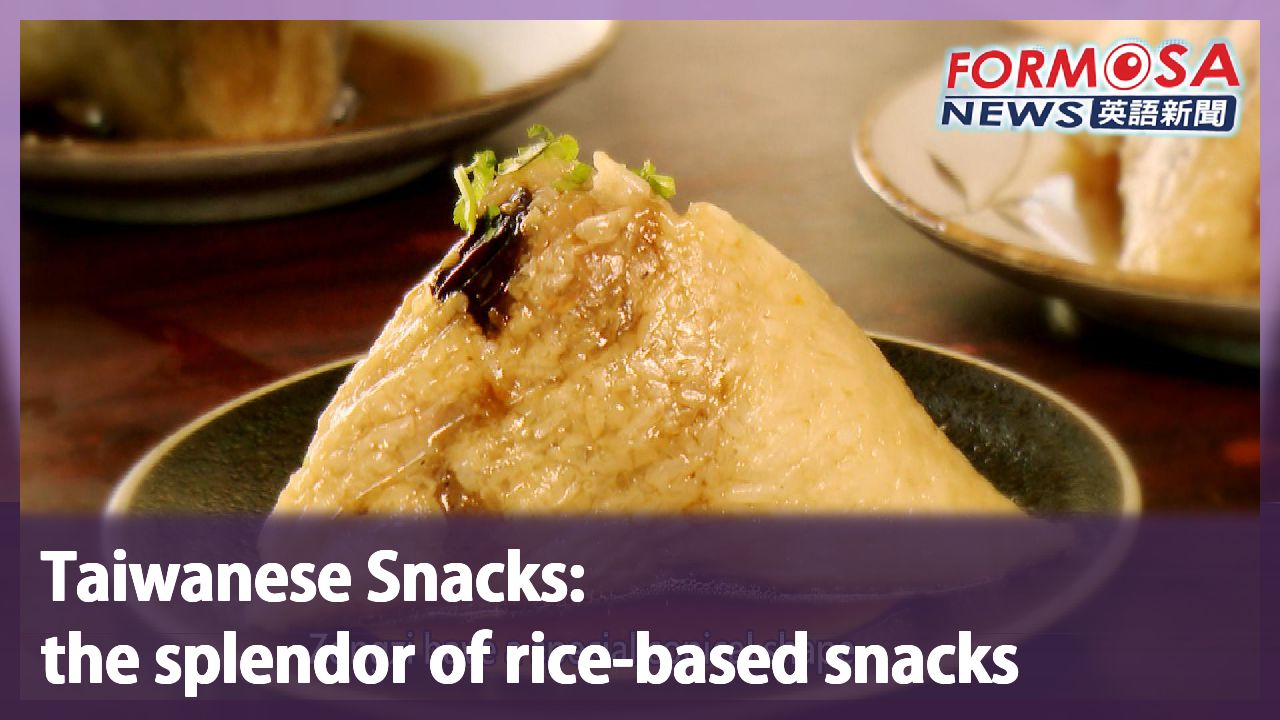
Zongzi have a special conical shape. Cut them open and they’re full of filling. The leaf wrapper infuses the rice with flavor. Zongzi are a delight to the eyes and the tastebuds. But making zongzi is a lot of work.
Stir-fried mushrooms are doused in pork broth. Meanwhile, premium pork is being prepared. There are many zongzi fillings, varying by region and personal taste. Southerners like peanuts; northerners like shrimps.
Other choices include pork belly, chestnuts, and of course, the star: a salted egg yolk. In the south, they use raw long-grain glutinous rice.
In the north, they season the glutinous rice, and steam-fry it half cooked.
Preparing the zongzi is hard enough, but wrapping it tight is the real test of the chef’s skill.
Wu Kuan-ting
Fifth-generation zongzi expert, Tainan
Makino bamboo wraps better. Sweet bamboo has a nicer flavor. First you fold it, then put the rice in, mushrooms, braised pork, cherry shrimps, lean meat, scallops, egg yolk, chestnuts. Finally some rice on top, mushrooms on top. Then you can close it, wrap it up.
You must leave the rice space to expand as it cooks. It can’t be wrapped too tight or too loose.
Wu Li-yuan
Fourth-generation zongzi expert, Tainan
If it’s too tight it will explode. Too loose doesn’t work either, it will leak. Some people like our zongzi. But in the end, mom’s zongzi are the best. Mom’s zongzi taste the best.
The wrapped zongzi are boiled in the south, but steamed in the north.
Overall, northern-style zongzi have a rich aroma, and each grain of rice is distinct. Southern-style zongzi are more soft and sticky. Both styles have their proponents.
Huang Wan-ling
Food writer
The northern zongzi are steamed. The rice was cooked first, it’s fixed with steam. The southern style is more difficult to make. If you wrap them too tight, they won’t cook. You can’t say one tastes better than the other. Whatever you prefer is the best. We can respect each other’s differences. No need to argue who’s No. 1!
There are many different types of zongzi. Longer zongzi originate from Chaozhou, China. Hunan zongzi have a simpler, pork-heavy filling.
Hakka zongzi fillings include pickled radish. “Alkaline zongzi” are transparent and sweet. White ginger lily zongzi taste like the flower. Local rice paired with local ingredients has led to many different flavors in different regions.
After WWII, braised pork zongzi were commonly sold by street hawkers: a nostalgic scene from pre-industrial society.
“Wrapping zongzi” sounds like “guaranteed win.” So that makes zongzi a very lucky omen for elections, or students taking exams.
Wu Mei-lan
Traditional zongzi store owner
Parents ask us to put in special fillings. But you can’t put the salted duck egg in if you want the kid to succeed. In the old days, information wasn’t so widespread. If a newspaper said, “Its going to rain blood!” “You must eat zongzi to clear the bad luck!” And then you took out a cart of zongzi, they’d sell out instantly.
Taiwanese snacks comprise the laborious zongzi and the simple danzai noodles; ba-wan, found only in Taiwan; oyster pancakes, made differently in many countries; and many other appetizing dishes.
They’re not just for the tastebuds, nor simply a vehicle for local culture. They also carry culinary memories linking us to meals in ages gone by.
For more Taiwan news, tune in:
Sun to Fri at 9:30 pm on Channel 152
Tue to Sat at 1 am on Channel 53
2024-09-15