Andreea Medar’s works preserve memories of a Romanian village
Andreea Medar’s works preserve memories of a Romanian village
2025-04-02
Today, we take you to see the works of Romanian artist Andreea Medar. In her new exhibition in Taipei, she displays her embroidery works made with different materials. The works are inspired by the village she grew up in. FTV reporter Stephany Yang takes us in for a look!
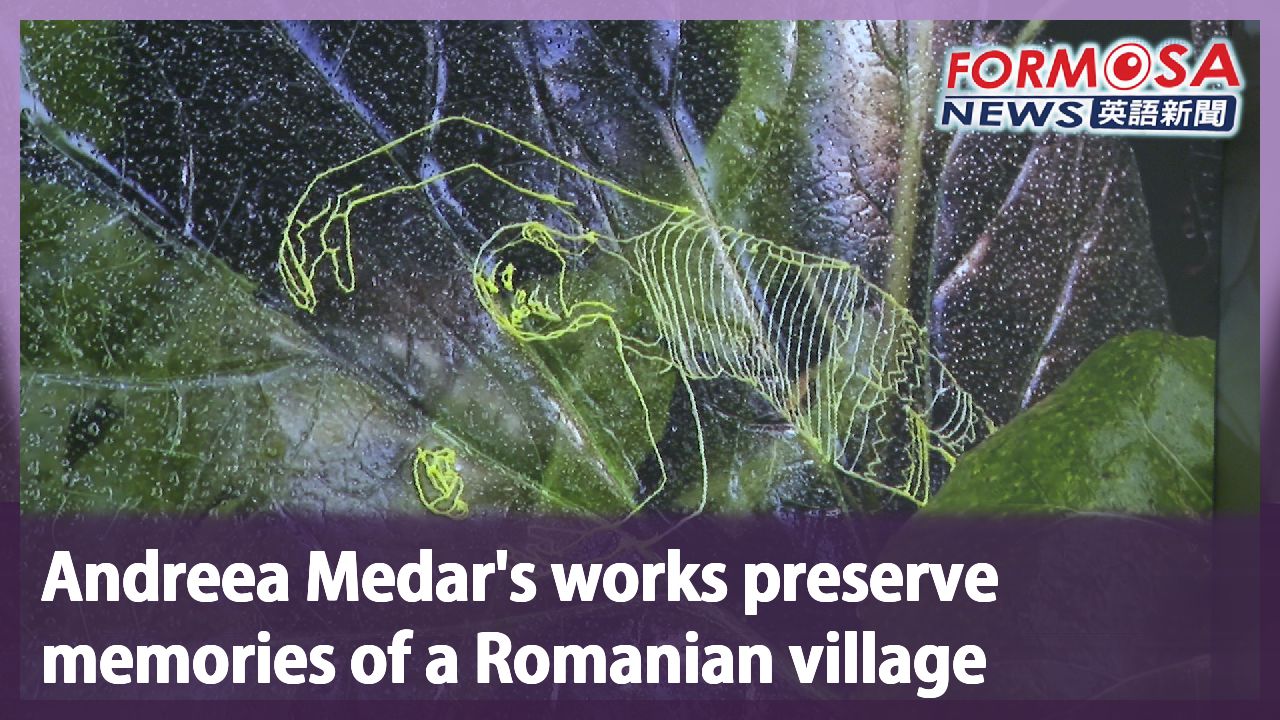
Andreea Medar utilized hand embroidery techniques and materials such as fluorescent pigments, polycarbonate, aluminum, glass beads, epoxy and more to create these works. Her works reference Racoți Village in Romania where she grew up. She stitched plants and people.
Sisy Wang
Kuandu Museum of Fine Arts curator
Andreea Medar has a PhD in painting, but she uses her painting skills in the media she creates with now. She uses a lot of embroidery and plastic sheets. Later, she expanded to aluminum sheets. Embroidery and plastic sheets are closely related to her family’s memories because her works explore the family’s home and her hometown over several generations. Her hometown is in a village called Racoți in southern Romania. Over the past 150 years, this village has gone from prosperity to decline and has experienced a period of social change, which affected the people living in it. Why is embroidery important? Because at that time, when war broke out, the men in the village were conscripted to the battlefield, and the women had to support the family. They would make embroidery to support the family.
Medar’s art spans various mediums, including embroidery, sculptures, video, and media installations. Her works explore themes like family history, rural communities, and societal changes. Medar’s first solo exhibition in Taipei delves into her family and Romanian history, as well as women’s rights. It is accompanied by a timeline of her family’s history and Romania’s history from WWI to WWII. There are also precious photos and documents from her home. She hopes to preserve her village’s precious memories through her works.
Sisy Wang
Kuandu Museum of Fine Arts curator
She projected giant plants and also sewed portraits of her grandmother or relatives. Why plants? Because there are many plants near her village, and the plants are slowly disappearing. She told me something that moved me very much. She said that she was the last caretaker of this garden. She wants to continue this mindset through artistic creation. The artist also brought precious historical materials from their family, including old photos and documents related to her family and the government.
Her exhibition titled "Since the Wood of Your Window Has Been Blooming" is organized by the Kuandu Museum of Fine Arts and Mind Set Art Center. It is now on view until May 18 at the Kuandu Museum of Fine Arts in Taipei.
For more Taiwan news, tune in:
Sun to Fri at 9:30 pm on Channel 152
Tue to Sat at 1 am on Channel 53
羅馬尼亞藝術家個展 以刺繡探討記憶與歷史流變
2025-04-02
羅馬尼亞藝術家安德利亞.梅達爾在台首次個展,在展覽中,展示由不同材料製成的刺繡作品。這些作品的靈感來自於她長大的村莊,羅馬尼亞南部拉柯伊村的歷史脈絡與當代處境。
安德利亞.梅達爾利用手工刺繡技術和螢光顏料、聚碳酸酯、鋁、玻璃珠、環氧樹脂等材料來創作這些作品。靈感來自於她長大的羅馬尼亞拉科西村。作品多描述植物和人。
[[關渡美術館策展人 王叡栩]]
"Andreea Medar是繪畫專長的博士,但是她把她的繪畫技巧用在她現在創作的媒材裡。大量透過刺繡,塑料布,後來會延伸到鋁片,這些不同的媒材。刺繡跟塑料布,其實跟她的家族記憶很有關,因為她其實在討論的是她家世世代代的家屋,她的老家。她的老家是在羅馬尼亞南部叫做Racoți的村莊,這村莊150幾年來,從繁榮到沒落,其實經歷了一段的社會變遷,包括裡面居住的人。為什麼刺繡很重要是因為當時,戰爭的時候,村莊的男性被徵召去戰場,女性必須要扛起家計,她們會透過刺繡"
Andreea Medar的藝術跨越多種媒介,包括刺繡、雕塑、錄像和媒體裝置。她的作品探索家族歷史、農村社區和社會變遷等主題。梅達爾在台北的首次個展深入探討一戰與二戰期間影響下,她的家庭和羅馬尼亞歷史脈絡以及婦女權利,更展出珍貴的家庭照片和文件。她希望透過自己的作品保留村莊的珍貴記憶。
[[關渡美術館策展人 王叡栩]]
"投射了巨像性的植物,還有縫製奶奶或是親戚的人像。為什麼是植物?因為她的村莊附近有很多植物,植物慢慢的沒落了,他說了一句話我覺得很感動,他說他是這一個花園最後一個園丁。她透過藝術創作再延續這份精神,藝術家也帶來他們家族很珍貴的史料,包括老照片還有她家以及跟政府有關的文件"
《從你的窗櫺開始綻放以來》展覽於關渡美術館展出至 5 月 18 日。
更多新聞內容,請鎖定:
民視台灣台(152頻道)週日至週五晚上9:30
民視新聞台(53頻道)週二至週六凌晨1:00
Related News