Attitudes on organ donation evolve amid taboos and traditional beliefs
Attitudes on organ donation evolve amid taboos and traditional beliefs
2025-04-13
Taiwan is among the top countries in Asia for organ transplants, with high success rates and long life spans for recipients. But there is one cultural issue that’s potentially holding back progress. Traditional beliefs that only intact bodies move on to the next life and taboos surrounding death make for a very low willingness to donate organs. That means that in many cases, the family members of deceased donors refuse to go ahead with organ donation. But there is a growing movement to change things, promoted by relatives of donors, organ recipients, filmmakers and tech experts. Our Sunday special report.
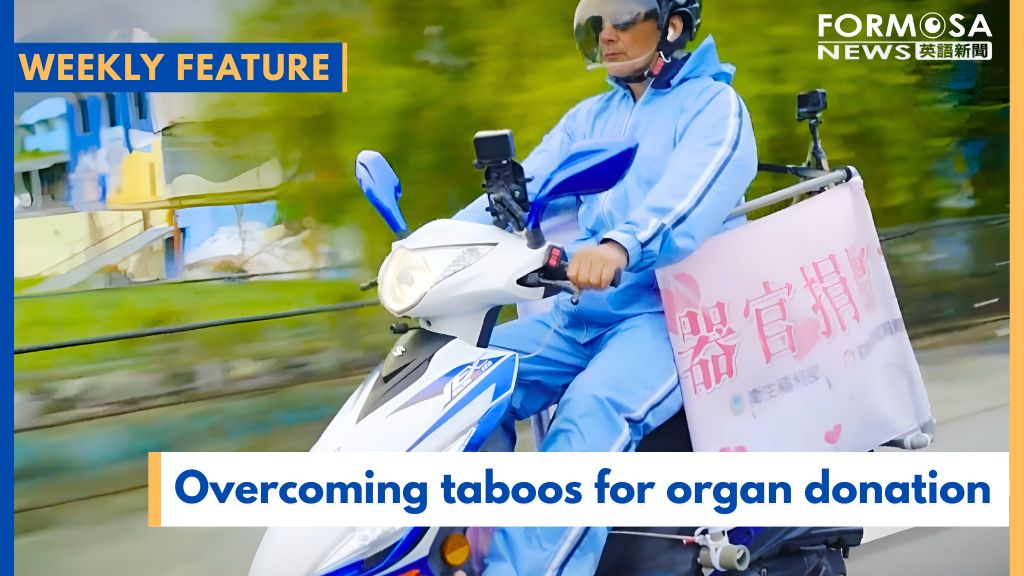
A scooter zips across a lush mountainscape with a banner encouraging organ donations. This round-the-island road trip is Yang Sung-ling’s way to celebrate his 70th birthday and to commemorate his late daughter.
In front of the cameras, he’s always promoting organ donation. So it’s hard to imagine his personal struggle with the issue when deciding whether to donate his dead daughter’s organs.
Yang Sung-ling
Organ donor’s father
Before I signed the document, I asked my daughter by casting divination blocks. When she passed, she was in her final year in high school, just 16 years old. And just like that she was gone. The grief and the pain were unbearable. So I cast the blocks to ask her. She agreed. It was only then that I signed the form.
Even after the donation, the decision caused Yang a lot of anguish. Before the procedure, he made a request to a social worker at the hospital: that the organ recipient send an anonymous letter to him after the operation. But that letter never came.
Yang Sung-ling
Organ donor’s father
All I wanted was a letter, or a note. I hoped that the recipient would tell me about how life had changed after the donation. I didn’t want to know their name, or their address. The idea was for the hospital to forward the note to me. They agreed, and said there was no problem. But after the donation, I never heard back. It’s been nine years of silence. It made me wonder whether I had made the right call.
The helplessness and doubts tormented Yang for nine years. But it all came to an end when he met nine organ recipients at an event for relatives of organ donors.
Yang Sung-ling
Organ donor’s father
I hadn’t shed a single tear from the day my daughter died to the day of the donation. But that day I did. I had been holding back my tears, swallowing them down. But that day I cried of happiness, because the weight in my heart had been lifted. It proved to me that I had made the right decision.
Yang is not alone in his experiences as a relative of a deceased organ donor. As discussing death is taboo in Taiwanese society, few people dare to bring up the topic with their families. Since the wishes of the deceased can’t be confirmed, the decision often falls on the relatives, leaving them in a big dilemma.
Tsai Hung-bin
Taiwan Organ Registry and Sharing Center
When you haven’t asked your parents about the matter, how can you be sure they wanted to donate their organs? Perhaps you never heard them say anything about donation. You making that decision for them can feel a little unfilial. So rather than risk going against their parents’ wishes, some would rather just say no.
A TV series about the mediation process for organ donations premiered in late 2018. “The Coordinators” had fantastic ratings, and raised awareness about the issue in Taiwan.
Yang Chung-tien
Organ donor documentary producer
During the two months that the series was on, the number of people with donor cards increased by 400%.
After working as a producer in “The Coordinators” Yang Chung-tien realized serious topics like organ donation could be packaged in a way that sparks discussions in society. In August 2024, he got a team together to shoot a documentary about organ donation.
Yang Chung-tien
Organ donor documentary producer
It shouldn’t just be like a firework, shining for a bit and disappearing with a bang. We were thinking about how we can make it so that the issue draws attention for a long time and gets more people to understand it. So we tried using different approaches to move everyone and motivate them to stay engaged.
The production team turned a serious life-and-death topic into a palatable story that made it easier for people to breach the subject of organ donations. But being mentally prepared for a donation is sometimes not enough to ease the painful loss for relatives of donors. That’s where technology comes in.
Thin threads of cornstarch are piped layer by layer to make a smooth surface. In just one and a half hours, the machine prints out a small heart that can fit in your palm.
Even unpainted, the shell looks very realistic. That’s because it was modeled after a real human heart from a computer tomography scan. The virtual model was made smaller and brought to the physical world with a 3D printer. These fake organs have a very specific mission: to fill in the gap left by the removed organs in the body of the donor.
Liu Bing-xun
3D-printed organ program head
Our organs have weight and take up space in the body. An adult liver weighs at least 3kg, and can weigh more than 5kg. If you remove the organ, that causes the body to sink in at the spot to some extent. So these 3D-printed organ models can be put inside the body of the donor, where they act as support.
In 2023, nursing student Liu Bing-xun was an intern at Taipei Medical University Hospital. That’s where he saw first-hand the conflicted feelings of donors’ family members, who were concerned that their relative’s body wasn’t intact at death as tradition mandates. He decided to start a program to provide 3D-printed organs to donors and as of 2024, he’s helped out in more than 20 transplants. What’s more, in seven instances, the families of donors only agreed to the donation after seeing his models.
Liu Bing-xun
3D-printed organ program head
Some older generations believe that removing organs after death will render the body incomplete, which could negatively impact the deceased in their next life. I tell them that the hospital will place a new organ inside the body so that it is complete, so that nothing’s missing. That makes them more likely to agree to donate.
Lee Ming-che
Taiwan Organ Registry and Sharing Center
A lot of the things we do are not for the sake of the donors, but actually so that their living relatives don’t regret their decision. So in a way, it is about keeping their love intact.
With more than 10,000 patients waiting for life-saving transplants, people from all walks of life are trying to raise awareness about the importance of organ donations. For many recipients, an organ is a second chance at life.
Hopping and flexing around the gym is Huang Chien-yu, who eight years ago received a heart transplant after suffering a myocardial infarction. He’s since tried to keep up his previous exercise habits, but now, every time he gets a move on, it’s a bit of a gamble with fate.
After every exercise, Huang checks his smart watch to monitor his heart rate. The heart he received was a little too big for his chest, and has had some impact on his lung capacity. During intense training, he sometimes finds himself in a state of temporary hypoxia.
Huang Chien-yu
Heart recipient
I compare it to running with a bucket of water in front of you. You run for 10 minutes and then you dip your head in the water. That’s what it feels like when I get low on oxygen. It’s a difficulty I have to overcome every time I work out.
While waiting for a heart transplant, Huang suffered a stroked that compressed his optic nerves. That left him blind in his left eye and with a visual acuity of 0.1 in his right eye. But still he did not give up on himself. Besides working hard to recover, he tried to make the most of his second chance at life, exercising, writing books and giving talks about his experience. At his first ever public speech, he met some very special attendees, the relatives of his heart donor.
Huang Chien-yu
Heart recipient
At my first public talk, I told my story. And afterwards, some people came to chat with me. I told them about the time I collapsed, the situation and my blood type and all that. Everything added up. I asked them if they had brought my thank-you letter. They had, and when I saw that it was my own handwriting, we all hugged each other and bawled our eyes out.
The families of the recipient and the donor did not meet again. But one day, a volunteer sent Huang a photograph. In it was the daughter of his donor’s son.
Huang Chien-yu
Heart recipient
I brought the phone to my heart and spoke to him. I said “We’re grandparents!” I sat on my bed crying all afternoon. My mind kept telling me that it wasn’t actually my granddaughter, that it wasn’t my son who’d had a baby, that there was no reason to cry. But we have a very strong connection. I could tell he was over the moon. From my heartbeat, I could tell he was very happy.
About 50% of patients who get a heart transplant at Cheng Hsin General Hospital live for more than 10 years. And about 35% live for more than 20. Huang says he is hoping to become a miracle of modern medicine.
Huang Chien-yu
Heart recipient
Death is not easy at all. But isn’t living to the fullest an immensely brave thing to do? These past eight years I repeat the same thing over and over again. Everything I do is to prove to the families of donors that their love can live on as long as we make the most of our lives.
For more Taiwan news, tune in:
Sun to Fri at 9:30 pm on Channel 152
Tue to Sat at 1 am on Channel 53
#OrganTransplant #OrganDonation #器官移植 #器官捐贈
死後留全屍、忌諱談生死 器官捐贈的生命課題該如何面對
2025-04-13
台灣醫界進行器官移植的技術,已經相當成熟,成功率跟存活率,在亞洲國家當中名列前茅,然而在推廣器官捐贈的觀念上,卻始終面臨瓶頸。「留全屍」的觀念、忌諱談生死,都是主要的障礙。今天的專題報導,要帶您來看看,捐贈者家屬、受贈當事人,媒體人,甚至是科技的導入,是如何努力的想讓民眾,正視器官捐贈這樣的生命課題。
騎機車穿梭在山林間,後座旗子隨風飄揚,上面寫著「器官捐贈」四個大字,這趟環島旅行,是楊松齡送給自己的70歲生日禮物,也是他紀念女兒的方式。
在鏡頭前積極推廣器捐的模樣,讓人很難想像,他在替女兒做器捐的決定之前,也曾因為不確定女兒的想法,陷入痛苦掙扎。
[[捐贈者家屬 楊松齡]]
“要簽之前,我還說再回去跟我女兒擲筊問問看,國三,16年,突然間,就這樣不見了,心裡上的割捨一定很大,痛也很大,就去跟她問,問到她同意了,我才簽”
沒想到捐贈後,楊大哥又再度面臨心理考驗,原來他曾向醫院社工請求,希望有受贈者配對到女兒的器官時,對方可以匿名寫一張卡片給他,然而,這張卡片,從未被送到他的手上。
[[捐贈者家屬 楊松齡]]
“我只拜託你給我一張、兩張,只要是受贈者,他們受贈後,生活改變的卡片給我,我不要知道他的名字,我也不要知道他的地址,他透過你們轉給我,他說好,沒問題。結果捐的那天以後,什麼消息都沒有,就這樣安安靜靜的九年,讓我覺得說,究竟我做器官捐贈的決定,是對是錯“
心裡的無奈,埋怨,持續長達九年時間,直到楊松齡在一場捐贈者家屬活動上,與九名器官受贈者們相遇了。
[[捐贈者家屬 楊松齡]]
“我女兒過世的那一天,到她到器官捐贈,我沒有哭過,那一天我哭了,眼淚是不敢往外流,往裡面吞,我哭是很高興的哭,因為我心裡的束縛總算解脫了,這就證實我做的事是正確的”
其實類似的心路歷程,在捐贈者家屬身上並不少見,因為華人傳統觀念忌諱談「死」,很少事先與家人溝通身後事,在無法確認當事人意願的情況下,家屬要代替對方下器官捐贈的決定,內心往往陷入兩難。
[[器捐及病主中心執行長 蔡宏斌]]
“我們做子女的,我也沒問過老人家,你怎麼知道說他要捐,好像我沒有聽過他同意我要捐,這在孝道上面好像有一點點,大家覺得不安,如果說有一點冒犯長輩的意思,他們就寧可退回來”
2018年年底,以器官捐贈協調師為主角的職人劇《生死接線員》,在電視台首播,不只創下收視紀錄,更成功帶動社會上討論器捐的風潮。
[[器捐紀錄片《第二次人生》監製 楊中天]]
“兩個月的播出期間,器官捐贈的器捐卡簽署率,成長了400%”
曾參與《生死接線員》的製作,楊中天發現以影視作品,包裝器捐這樣的嚴肅議題,有助於社會大眾開口討論,因此在2024年8月,再度和團隊一起籌劃,拍攝器捐紀錄片《第二次人生》。
[[器捐紀錄片《第二次人生》監製 楊中天]]
“這不應該只是一個煙火而已,煙火放下去很燦爛,蹦一下放出來,但是放完了之後,怎麼樣長期把這個議題,讓大家持續地能夠關心,去了解,才毅然決然地,覺得我們要繼續用不同的方式,讓大家感動,繼續看下去”
影視製作團隊以軟性故事,包裝嚴肅的生死議題,讓家人之間開口談器捐,變得比較容易,但即便事先做好心理建設,到了真正的關頭,捐贈者家屬捨去摯愛心肝的痛,依然難以緩解,科技的介入,是否能帶給他們一絲安慰。
纖細的玉米澱粉線,在光滑的平面上層層堆疊,經過一個半小時,一顆成人手掌,一半大小的迷你心臟成形了。
還沒上色,就可以看出外型逼真,因為它其實是用電腦斷層掃描,真實的人體器官之後,縮小,再3D列印出來的。這些人體器官模型,肩負特殊任務,在捐贈者捐出器官後,會被放回捐贈者體內,進行「器捐填補」。
[[北醫護理系3D列印器捐填補計畫負責人 劉秉勳]]
“我們器官都是有重量、體積的,成人的肝臟來講,大概至少有3到5公斤以上,其實整個肝臟拿掉的情況下,多多少少體表會有凹陷下去,這樣3D列印的器官,將立體模型重新置放回器捐者體內,其實主要讓它有更好的支撐”
2023年,劉秉勳在北醫附醫實習時,曾目睹器官捐贈者的家屬,因為「留全屍」觀念,深陷矛盾情緒,決定推動「3D列印器捐填補計畫」。截至2024年,他和團隊已經協助超過20名捐贈者進行器捐填補,還有7例的案例,是因為看到了他的模型,才同意捐贈。
[[北醫護理系3D列印器捐填補計畫負責人 劉秉勳]]
“一些長輩會覺得,死後如果摘取器官,會少一樣東西,或是說對他來生會有影響,有些家屬可能會去,跟他們的長輩解釋說,醫院有幫我們重新放一個回去,他其實是完整的,他沒有被拿走什麼,相對來講,長輩會比較好接受”
[[器捐及病主中心董事長 李明哲]]
“我們現在做這些,很多事情的目的,不是為了捐贈者而做而已,更重要的是,為了這些活著的人而做,讓他們不要有遺憾,所以我們就說是叫做,「填補缺損的愛」”
隨著各行各業的一同推動,台灣的器捐率,未來或許有機會往上攀升,對上萬名仍在排隊,等待器官救命的病患來說,他們也因此更有機會,能夠展開精彩的第二人生。
在健身房裡活蹦亂跳的模樣,讓人幾乎忘了黃健予8年前,才因為心肌梗塞完成換心手術,術後,黃健予依然保持過去的運動習慣,但現在每次動起來,對他而言,都是一場與命運的賭博。
每做完一個動作,都得立刻查看自己的智慧手錶,檢查心跳,原來這顆心臟,對黃健予的胸腔來說太大了,已經影響到他的心肺功能,只要他稍微激烈運動,就會陷入短暫的缺氧狀態。
[[心臟受贈者 黃健予]]
“我常舉個例子說,你就在跑步機前面放一盆水,跑了十分鐘,你把頭埋在水裡面,這大概就是當時,我在運動缺氧的狀況,當我每一次運動,我都要克服這個情形”
在等待換心的過程中,黃健予還不幸腦部中風,壓迫視神經,導致左眼失明,右眼的視力也僅剩下0.1,但他沒有自暴自棄,意外得來的人生後半場,他沒浪費,不只辛勤復健,更開始寫書,四處演講,而就在他的第一場演講上,他與自己的捐贈者一家人,意外相認了。
[[心臟受贈者 黃健予]]
“我第一次演講,故事講得好完整,講完之後,就真的碰到他們來跟我聊天,聊當時我倒下的時間,倒下的狀況,我的血型,我的各方面,好像都吻合,我問他們有帶感謝函來嗎,他說有,然後再看是我的筆跡,那一刻,兩家人就抱在一起大哭”
雖然兩家人此後再也沒有私下見面,但對方曾透過志工捎來一張照片,原來是心臟捐贈者的兒子,生了一名可愛的女兒。
[[心臟受贈者 黃健予]]
“我把手機貼著我的心上,我跟「老哥」說,「老哥」我們做阿公了耶,我就坐在床邊哭了一個下午,我心裡想說,又不是我兒子,又不是我孫子,我哭什麼,但是心靈相映那種感覺是存在的,我感覺到他是一直喜悅的,因為他在心悸,我相信他一定很開心”
黃健予笑著說,在振興醫院進行換心手術的人當中,有50%活了超過十年,35%活超過20年,而自己立志要成為「醫學奇蹟」。
[[心臟受贈者 黃健予]]
“死亡固然不容易,但認真活著,又何嘗不是一件很勇敢的事情,我覺得這八年來,我不斷地在重複,我所做的這些事情,只為了證明其實這些捐贈者家屬,他們給我們的這一份大愛,是可以永遠地傳遞下去,只要我們活得精彩”
更多新聞內容,請鎖定:
民視台灣台(152頻道)週日至週五晚上9:30
民視新聞台(53頻道)週二至週六凌晨1:00
Related News