Attitudes on organ donation evolve amid taboos and traditional beliefs
Taiwan is among the top countries in Asia for organ transplants, with high success rates and long life spans for recipients. But there is one cultural issue that’s potentially holding back progress. Traditional beliefs that only intact bodies move on to the next life and taboos surrounding death make for a very low willingness to donate organs. That means that in many cases, the family members of deceased donors refuse to go ahead with organ donation. But there is a growing movement to change things, promoted by relatives of donors, organ recipients, filmmakers and tech experts. Our Sunday special report.
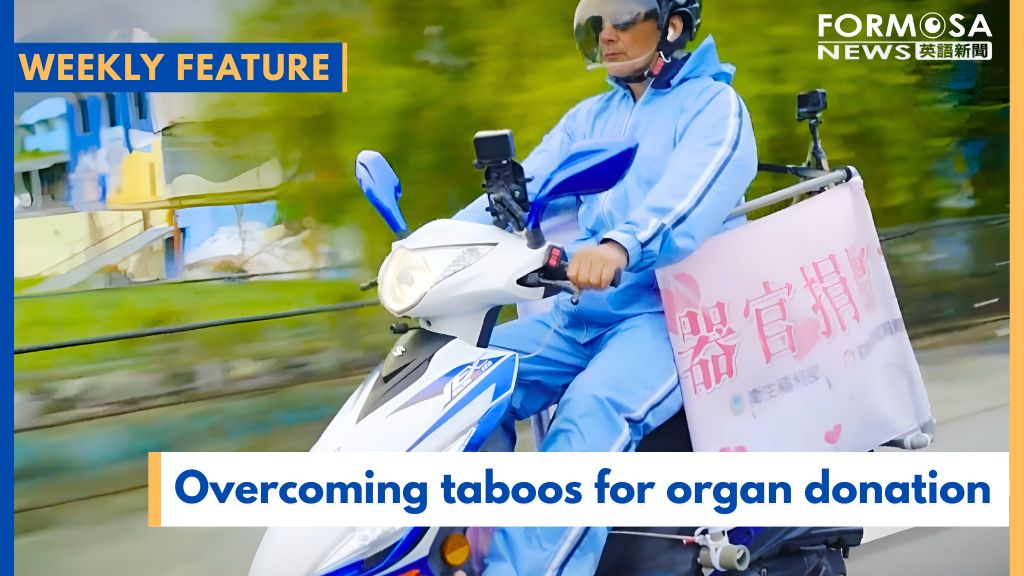
A scooter zips across a lush mountainscape with a banner encouraging organ donations. This round-the-island road trip is Yang Sung-ling’s way to celebrate his 70th birthday and to commemorate his late daughter.
In front of the cameras, he’s always promoting organ donation. So it’s hard to imagine his personal struggle with the issue when deciding whether to donate his dead daughter’s organs.
Yang Sung-ling
Organ donor’s father
Before I signed the document, I asked my daughter by casting divination blocks. When she passed, she was in her final year in high school, just 16 years old. And just like that she was gone. The grief and the pain were unbearable. So I cast the blocks to ask her. She agreed. It was only then that I signed the form.
Even after the donation, the decision caused Yang a lot of anguish. Before the procedure, he made a request to a social worker at the hospital: that the organ recipient send an anonymous letter to him after the operation. But that letter never came.
Yang Sung-ling
Organ donor’s father
All I wanted was a letter, or a note. I hoped that the recipient would tell me about how life had changed after the donation. I didn’t want to know their name, or their address. The idea was for the hospital to forward the note to me. They agreed, and said there was no problem. But after the donation, I never heard back. It’s been nine years of silence. It made me wonder whether I had made the right call.
The helplessness and doubts tormented Yang for nine years. But it all came to an end when he met nine organ recipients at an event for relatives of organ donors.
Yang Sung-ling
Organ donor’s father
I hadn’t shed a single tear from the day my daughter died to the day of the donation. But that day I did. I had been holding back my tears, swallowing them down. But that day I cried of happiness, because the weight in my heart had been lifted. It proved to me that I had made the right decision.
Yang is not alone in his experiences as a relative of a deceased organ donor. As discussing death is taboo in Taiwanese society, few people dare to bring up the topic with their families. Since the wishes of the deceased can’t be confirmed, the decision often falls on the relatives, leaving them in a big dilemma.
Tsai Hung-bin
Taiwan Organ Registry and Sharing Center
When you haven’t asked your parents about the matter, how can you be sure they wanted to donate their organs? Perhaps you never heard them say anything about donation. You making that decision for them can feel a little unfilial. So rather than risk going against their parents’ wishes, some would rather just say no.
A TV series about the mediation process for organ donations premiered in late 2018. “The Coordinators” had fantastic ratings, and raised awareness about the issue in Taiwan.
Yang Chung-tien
Organ donor documentary producer
During the two months that the series was on, the number of people with donor cards increased by 400%.
After working as a producer in “The Coordinators” Yang Chung-tien realized serious topics like organ donation could be packaged in a way that sparks discussions in society. In August 2024, he got a team together to shoot a documentary about organ donation.
Yang Chung-tien
Organ donor documentary producer
It shouldn’t just be like a firework, shining for a bit and disappearing with a bang. We were thinking about how we can make it so that the issue draws attention for a long time and gets more people to understand it. So we tried using different approaches to move everyone and motivate them to stay engaged.
The production team turned a serious life-and-death topic into a palatable story that made it easier for people to breach the subject of organ donations. But being mentally prepared for a donation is sometimes not enough to ease the painful loss for relatives of donors. That’s where technology comes in.
Thin threads of cornstarch are piped layer by layer to make a smooth surface. In just one and a half hours, the machine prints out a small heart that can fit in your palm.
Even unpainted, the shell looks very realistic. That’s because it was modeled after a real human heart from a computer tomography scan. The virtual model was made smaller and brought to the physical world with a 3D printer. These fake organs have a very specific mission: to fill in the gap left by the removed organs in the body of the donor.
Liu Bing-xun
3D-printed organ program head
Our organs have weight and take up space in the body. An adult liver weighs at least 3kg, and can weigh more than 5kg. If you remove the organ, that causes the body to sink in at the spot to some extent. So these 3D-printed organ models can be put inside the body of the donor, where they act as support.
In 2023, nursing student Liu Bing-xun was an intern at Taipei Medical University Hospital. That’s where he saw first-hand the conflicted feelings of donors’ family members, who were concerned that their relative’s body wasn’t intact at death as tradition mandates. He decided to start a program to provide 3D-printed organs to donors and as of 2024, he’s helped out in more than 20 transplants. What’s more, in seven instances, the families of donors only agreed to the donation after seeing his models.
Liu Bing-xun
3D-printed organ program head
Some older generations believe that removing organs after death will render the body incomplete, which could negatively impact the deceased in their next life. I tell them that the hospital will place a new organ inside the body so that it is complete, so that nothing’s missing. That makes them more likely to agree to donate.
Lee Ming-che
Taiwan Organ Registry and Sharing Center
A lot of the things we do are not for the sake of the donors, but actually so that their living relatives don’t regret their decision. So in a way, it is about keeping their love intact.
With more than 10,000 patients waiting for life-saving transplants, people from all walks of life are trying to raise awareness about the importance of organ donations. For many recipients, an organ is a second chance at life.
Hopping and flexing around the gym is Huang Chien-yu, who eight years ago received a heart transplant after suffering a myocardial infarction. He’s since tried to keep up his previous exercise habits, but now, every time he gets a move on, it’s a bit of a gamble with fate.
After every exercise, Huang checks his smart watch to monitor his heart rate. The heart he received was a little too big for his chest, and has had some impact on his lung capacity. During intense training, he sometimes finds himself in a state of temporary hypoxia.
Huang Chien-yu
Heart recipient
I compare it to running with a bucket of water in front of you. You run for 10 minutes and then you dip your head in the water. That’s what it feels like when I get low on oxygen. It’s a difficulty I have to overcome every time I work out.
While waiting for a heart transplant, Huang suffered a stroked that compressed his optic nerves. That left him blind in his left eye and with a visual acuity of 0.1 in his right eye. But still he did not give up on himself. Besides working hard to recover, he tried to make the most of his second chance at life, exercising, writing books and giving talks about his experience. At his first ever public speech, he met some very special attendees, the relatives of his heart donor.
Huang Chien-yu
Heart recipient
At my first public talk, I told my story. And afterwards, some people came to chat with me. I told them about the time I collapsed, the situation and my blood type and all that. Everything added up. I asked them if they had brought my thank-you letter. They had, and when I saw that it was my own handwriting, we all hugged each other and bawled our eyes out.
The families of the recipient and the donor did not meet again. But one day, a volunteer sent Huang a photograph. In it was the daughter of his donor’s son.
Huang Chien-yu
Heart recipient
I brought the phone to my heart and spoke to him. I said “We’re grandparents!” I sat on my bed crying all afternoon. My mind kept telling me that it wasn’t actually my granddaughter, that it wasn’t my son who’d had a baby, that there was no reason to cry. But we have a very strong connection. I could tell he was over the moon. From my heartbeat, I could tell he was very happy.
About 50% of patients who get a heart transplant at Cheng Hsin General Hospital live for more than 10 years. And about 35% live for more than 20. Huang says he is hoping to become a miracle of modern medicine.
Huang Chien-yu
Heart recipient
Death is not easy at all. But isn’t living to the fullest an immensely brave thing to do? These past eight years I repeat the same thing over and over again. Everything I do is to prove to the families of donors that their love can live on as long as we make the most of our lives.
For more Taiwan news, tune in:
Sun to Fri at 9:30 pm on Channel 152
Tue to Sat at 1 am on Channel 53
#OrganTransplant #OrganDonation #器官移植 #器官捐贈
2025-04-13