ITRI hosts conference on renewable energy storage
ITRI hosts conference on renewable energy storage
2025-06-12
The Industrial Technology Research Institute, or ITRI on Wednesday held a conference on energy storage and grid resilience. Renewables play a crucial role in achieving the global target of net-zero emissions by 2050. However, its greatest weakness is that of intermittency. Energy storage systems are therefore needed to stabilize the grid, as renewables account for an increasing share of the energy mix. At the event, representatives of Taipower and other industry leaders discussed strategies to build relevant supply chains in Taiwan as well as facilitate the country’s transition towards net zero.
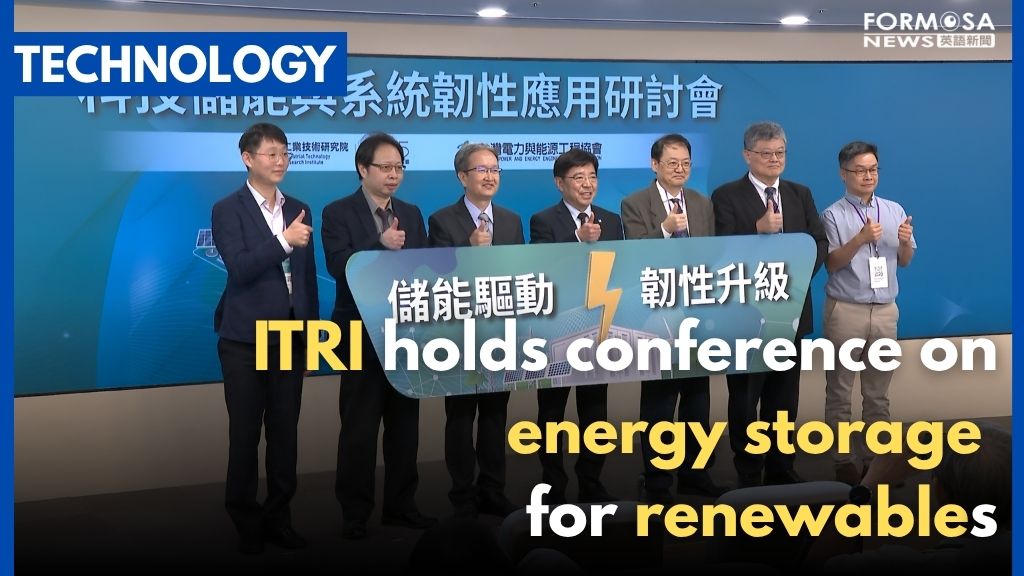
ITRI President Edwin Liu poses for a group photo with representatives of the Energy Administration, Taipower and other industry leaders at a conference on energy storage and grid resilience. In order to contribute to the global target of net-zero emissions by 2050, Taiwan is also actively promoting green and renewable energies, optimized by energy storage systems.
Edwin Liu
ITRI President
Energy storage and renewable energy are like dance partners. If there’s renewable energy, then it’s best to also have energy storage systems, or ESS. What ESS can do is stabilize and fortify electricity systems.
Energy storage greatly remedies renewable energy intermittency, balancing out the electricity levels of the grid during peak and off-peak hours. This ensures a stable electricity supply and optimizes renewable energy, which reduces net carbon emissions. Meanwhile, Taipower also shared how the company successfully prevented a mass blackout in the aftermath of the 2024 Hualien Earthquake that caused power unit trips. An electricity trading platform and energy storage systems allowed Taipower to dispatch privately generated electricity. Other industry representatives also suggested deploying behind-the-meter energy storage, so that Taiwan can achieve energy self-sufficiency of up to 80% to 90%.
Chen I-ping
Ensilience GM
Some industrial-grade energy storage systems with greater wattage are one with around 2 megawatts for two hours, and another with around 3 megawatts for two hours. They can both ensure uninterrupted electricity supply and even act in tandem with cogeneration systems. Combining renewables and storage applications helps factories save on electricity bills and also lowers carbon emissions.
Ivan Cheng
Ancillary Power
The whole world is working on reducing carbon emissions. Whether it’s wind or solar power, the greatest challenge to electricity systems posed by renewables is their greater intermittency and variability. For that distinctive characteristic, energy storage has important role to play.
Moreover, according to the International Energy Agency, the total energy storage volume is projected to be six times that of the present, offering immense business opportunities. At the conference, industry, government and academia are devising plans to create relevant supply chains to seize the opportunity while also help Taiwan achieve its net-zero targets.
For more Taiwan news, tune in:
Mon to Fri at 9:30 pm on Channel 152
Tue to Sat at 1 am on Channel 53
#technology #netzero #ESS #energystorage #SDGs #impact #COP30
瞄準龐大儲能市場 工研院攜手產業界"搶攻電力商機"
2025-06-12
為了達成2050淨零碳排目標,各國積極發展再生能源,但因為光電和風力有間接的特性,這時侯儲能系統就成為關鍵,可以調度能源,確保穩定供電。工研院舉辦研討會,找來台電和產業界代表,分享科技儲能的成功案例,期望能打造一條產業鏈。
工研院院長劉文雄與能源署、台電和產業代表出席研討會,聚焦科技儲能和強化電網韌性相關應用。邁向2050淨零碳排目標,台灣也積極推動綠能和再生能源,儲能技術就成為神隊友。
[[工研院院長 劉文雄]]
“儲能跟再生能源,是一個dancing partner,也就是舞伴,有再生能源的話,你最好也有儲能,所以儲能可以扮演的角色,當然就是說穩定電,電力系統的穩定,電力系統的韌性。”
為何儲能系統重要,就是因為再生能源有間歇的特性,儲能可以用來平衡用電高低峰,兼顧穩定供電和減碳趨勢。另外,台電也分享,去年0403強震造成機組跳脫,失去電量,靠著電力交易平台和儲能系統,調度民間電力才避免大規模停電。產業界也建置"表後儲能系統",優化場區能源使用,將近八到九成的電,可以自給自足。
[[永餘智能總經理 陳貽評]]
“工業用的等級,比較大型的MW的儲能系統建置,一個是大概2MW兩小時的電量,一個大概是3MW,也是兩小時的電量。做到一些不斷電應用,或者是做到,跟裡面的汽電共生的結合,再生能源跟儲能應用的搭配,來達到工廠它可以節省電費,然後降低碳排放。”
[[安瑟樂威執行長 鄭智文]]
“全世界都要做減碳。風電跟光電,可再生能源的最大挑戰,對電力系統的挑戰,就是它是相對間歇性,而且很容易變動性的,這樣的特殊的發電資源,所以儲能在這裡,就扮演非常重要的角色。”
根據國際能源總署統計,2030年全球儲能容量,會增加到目前的6倍之多,商機潛力無窮。產官研三方攜手,打造相關產業鏈,瞄準國際儲能市場龐大商機,並達到減碳永續目標。
更多新聞內容,請鎖定:
民視台灣台(152頻道)週一至週五晚上9:30
民視新聞台(53頻道)週二至週六凌晨1:00
Related News