ITRI hosts conference on renewable energy storage
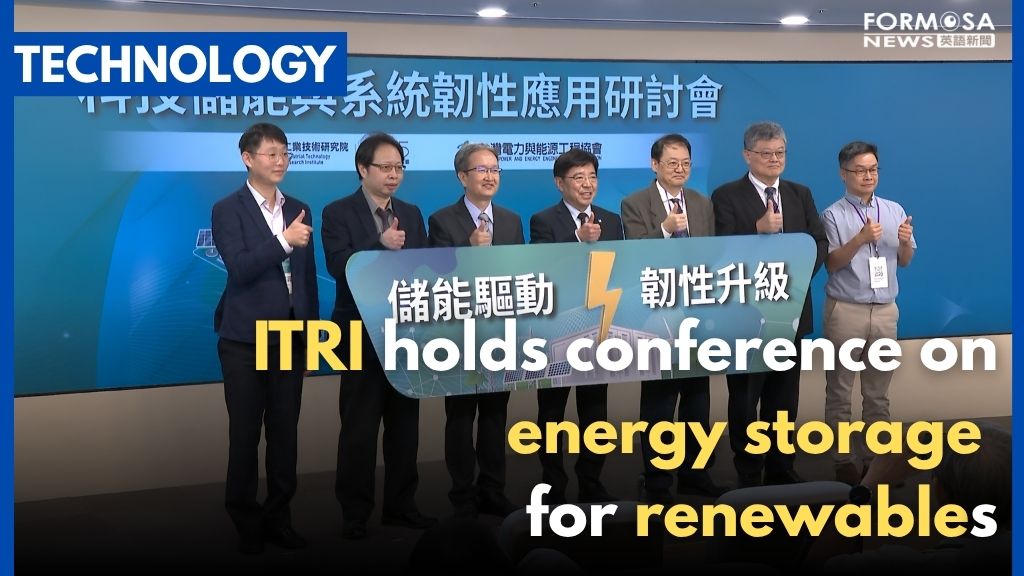
The Industrial Technology Research Institute, or ITRI on Wednesday held a conference on energy storage and grid resilience. Renewables play a crucial role in achieving the global target of net-zero emissions by 2050. However, its greatest weakness is that of intermittency. Energy storage systems are therefore needed to stabilize the grid, as renewables account for an increasing share of the energy mix. At the event, representatives of Taipower and other industry leaders discussed strategies to build relevant supply chains in Taiwan as well as facilitate the country’s transition towards net zero.
ITRI President Edwin Liu poses for a group photo with representatives of the Energy Administration, Taipower and other industry leaders at a conference on energy storage and grid resilience. In order to contribute to the global target of net-zero emissions by 2050, Taiwan is also actively promoting green and renewable energies, optimized by energy storage systems.
Edwin Liu
ITRI President
Energy storage and renewable energy are like dance partners. If there’s renewable energy, then it’s best to also have energy storage systems, or ESS. What ESS can do is stabilize and fortify electricity systems.
Energy storage greatly remedies renewable energy intermittency, balancing out the electricity levels of the grid during peak and off-peak hours. This ensures a stable electricity supply and optimizes renewable energy, which reduces net carbon emissions. Meanwhile, Taipower also shared how the company successfully prevented a mass blackout in the aftermath of the 2024 Hualien Earthquake that caused power unit trips. An electricity trading platform and energy storage systems allowed Taipower to dispatch privately generated electricity. Other industry representatives also suggested deploying behind-the-meter energy storage, so that Taiwan can achieve energy self-sufficiency of up to 80% to 90%.
Chen I-ping
Ensilience GM
Some industrial-grade energy storage systems with greater wattage are one with around 2 megawatts for two hours, and another with around 3 megawatts for two hours. They can both ensure uninterrupted electricity supply and even act in tandem with cogeneration systems. Combining renewables and storage applications helps factories save on electricity bills and also lowers carbon emissions.
Ivan Cheng
Ancillary Power
The whole world is working on reducing carbon emissions. Whether it’s wind or solar power, the greatest challenge to electricity systems posed by renewables is their greater intermittency and variability. For that distinctive characteristic, energy storage has important role to play.
Moreover, according to the International Energy Agency, the total energy storage volume is projected to be six times that of the present, offering immense business opportunities. At the conference, industry, government and academia are devising plans to create relevant supply chains to seize the opportunity while also help Taiwan achieve its net-zero targets.
For more Taiwan news, tune in:
Mon to Fri at 9:30 pm on Channel 152
Tue to Sat at 1 am on Channel 53
#technology #netzero #ESS #energystorage #SDGs #impact #COP30
2025-06-12