34,000 job openings available in Taiwan’s semiconductor industry
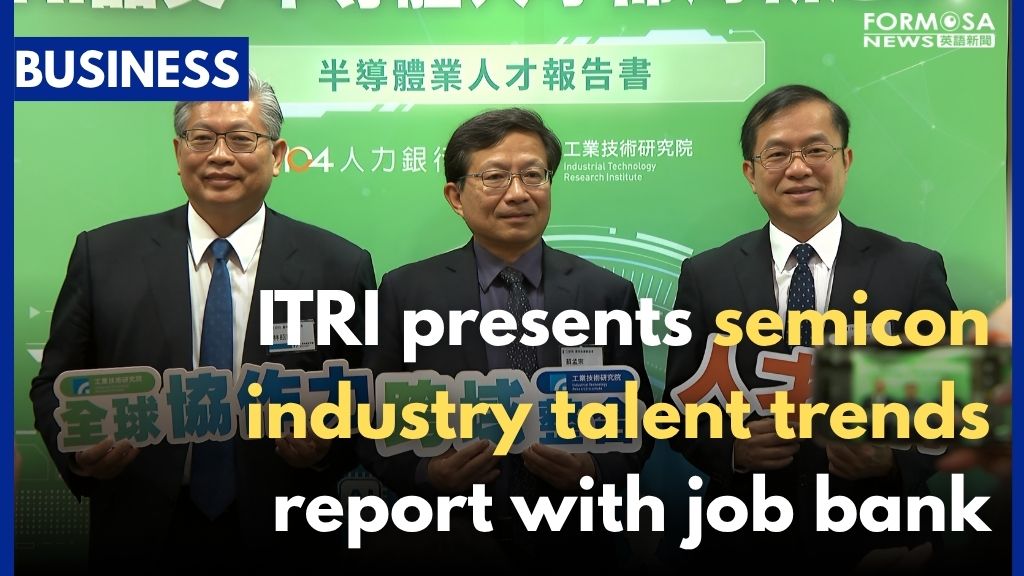
With falling birth rates amid an ageing population, Taiwan now has 34,000 job vacancies in the semiconductor industry, with openings available even to non-engineering talent. To address the issue, ITRI and a job bank teamed up to compile a 2025 report for talent trends in the industry. On Monday, key findings and conclusions in the reported were presented to the public. Let’s find out more.
Jeff Lin
ITRI Vice President
The only region in Taiwan where the birthrate is increasing is basically only the Hsinchu area.
ITRI Vice President Jeff Lin does not sugar-coat the reason Taiwan is experiencing a labor shortage: falling birth rate and population ageing. To address the issue, ITRI has teamed up with a job bank to publish a 2025 report on semiconductor industry talent trends. It concluded that in addition to filling job vacancies, AI will also play an important role in keeping operations running in Taiwan, an AI hub.
Stephen Su
ITRI Senior Vice President
Almost 70% of jobs now require AI-human collaboration. For example, if you used to do integrated circuit design, now AI can help you with 70% of the work. As for your decision-making and how you can find international partners for your intellectual property, that’s the remaining 30%.
The report found that the largest number of vacancies is related to production, quality control and industrial hygiene, with 9,968 job openings in May this year. Following up was research and development of advanced manufacturing processes and 3D chips, with 9,316 vacancies. The third highest number was that of technical operations. All in all, there were as many as 34,000 positions waiting to be filled.
Chung Wen-hsiung
Jobseekers’ website vice president
Taiwan’s labor force participation rate in the middle-to-late and late career stages still ha plenty of space for growth compared to other countries.
Why though, are there not enough technicians? The key reason could be that these roles are shift work that requires a high level of operation. It also could be that the jobs do not require a related educational background, which is the case with as many as 58% of current talents. On the other hand, the research and development of manufacturing processes can only be done by those educated in electrical engineering or mechanical engineering. However, the big question remains: is Taiwan ready as the industry expands to other countries?
Jeff Lin
ITRI Vice President
As for institutional and cultural challenges, because it’s a whole new environment, so there’s not a single country that can be said to be fully prepared. We don’t have a large market or a large population. Any breakthrough relies on reaching beyond our current talent pool and rethinking what it takes to fulfill a role in this industry.
Non-traditional talent with a liberal arts, social science or business background has emerged as the biggest winners amid current industry trends. On average, salaries for operations and project managers have grown by nearly 20%, for an annual median income of NT$1,239,787. That makes for an average monthly income of over NT$100,000. It seems that businesses in the industry may have to offer better compensation and benefits in order to attract top talents.
For more Taiwan news, tune in:
Mon to Fri at 9:30 pm on Channel 152
Tue to Sat at 1 am on Channel 53
#semiconductors #techindustry #jobs #jobsearch #semiconductorjobs #careergrowth
2025-07-28