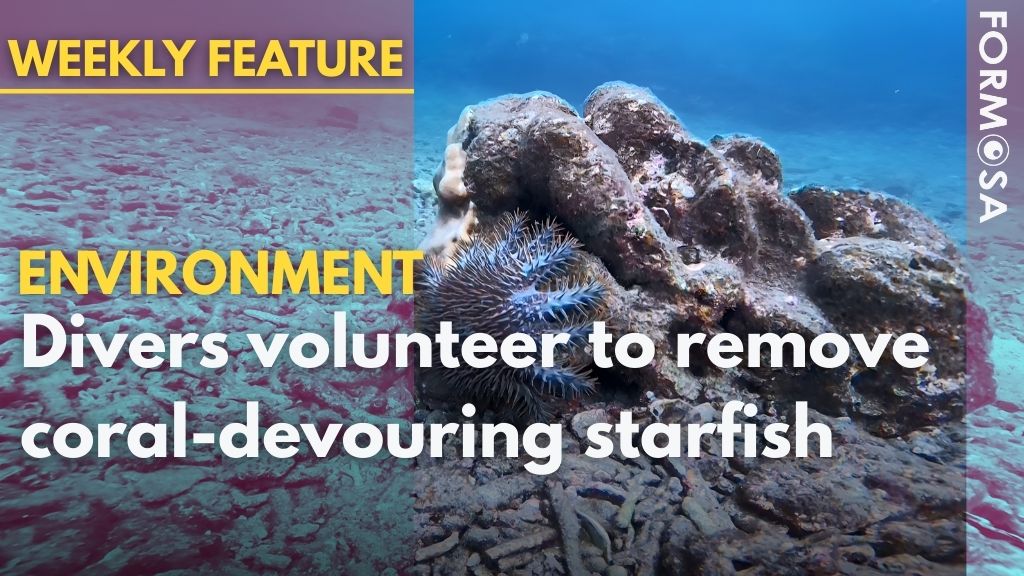
Volunteers in Penghu remove coral-devouring starfish to save precious reefs
A starfish outbreak is threatening to destroy Penghu’s beautiful coral reefs. This year, the number of crown-of-thorns starfish exploded so much so, that the population is already up to 20 times bigger than the threshold for the amount of living corals to stay constant. To save the corals, local volunteers are taking to removing the starfish one-by-one underwater. However, local government officials say there has to be a long-term solution. Our weekly special report.
This is Penghu’s southernmost island of Qimei. Following in the footsteps of local snorkeling coaches, we’re at Yueli Bay. It’s also the earliest port for local fishermen. The waters here are quite calm, attributable to the inward, crescent-shaped curvature of the bay. It’s also the only water recreation zone on Qimei.
Chan Deng-kai
Snorkel operator on Qimei
This is the Wuoniu area of Yueli Bay. Usually when we do tours, we enter the waters from here. This is also where you can find our most beautiful purple corals, which we call the lavender corals.
The purple staghorn coral fields are popularly referred to as “lavender forest” and attract numerous visitors to snorkel every year. According to the Taiwanese Coral Reef Society, the area boasts a healthy coral coverage rate of 70.5%. However, starting from May this year, an organism with multiple arms and completely covered in spines is threatening the area’s coral population.
The coaches are ready with full diving gear, tongs and carriers to capture the unwanted creatures.
Chan Deng-kai
Snorkel operator on Qimei
In the past we would only see single digits of them. But this year we’ve already caught 56.
They’re removing the crown-of-thorns starfish hiding in the reefs. The crown-of-thorns starfish preys on live corals and could even kill entire colonies.
Hernyi Hsieh
Penghu Fishery Research Center
The starfish we normally speak of has five legs, but the crown-of-thorns starfish’s number of legs is way more than that. Its legs are covered in many sharp spines, which are filled with toxin glands. So when a human or organism comes into contact with it, that could result in great harm.
Jeng Ming-Shiou
Academia Sinica Biodiversity Research Center
Someone had their whole finger sore for three months and really swollen. Another one of my colleagues got three fingers stung. In his case, he still felt a throbbing pain after a year and a half. So it’s a protein neurotoxin that stays inside.
The crown-of-thorns starfish has always existed off Qimei, so why are people hunting them all of a sudden now?
Chan Deng-kai
Snorkel operator on Qimei
If their population suddenly explodes—and they reproduce very quickly—if there’s an outbreak, they would quickly devour the corals and may even wipe out corals.
Chan Deng-kai has done watersports for over 18 years, and he often gives snorkeling tours for visitors to admire the corals. He didn’t know much about the crown-of-thorns starfish, except that they were venomous. But now he’s forced to acknowledge their existence, because there are simply so many.
Lu Chi-chun
Qimei Township head
These crown-of-thorns starfish were caught in May and June this year by volunteer divers. Look, they’ve caught so many, an entire bucketful of crown-of-thorns starfish.
The head of Qimei Township, Lu Chi-chun says it’s snorkel operators that first discovered the outbreak. After calculations, it’s estimated that there are almost 250 starfish per hectare, way above the 10 to 15 threshold for the coral population to stay sustainable.
Lu Chi-chun
Qimei Township head
The entire Yueli Bay area, from the offshore to the open sea, is covered in coral. That’s why we’re worried about the crown-of-thorns starfish. They release spawns in the billions, which is terrifying. That’s why we’re concerned. If the crown-of-thorns starfish grows and matures, it could cause a lot of damage to our coral. This is why many of us are concerned, because the corals under the sea in Qimei are the most beautiful.
The high density of starfish at the bottom of the sea is a terrifying sight to behold. This was taken off Pratas Island, the area with the highest crown-of-thorns starfish population under Taiwan’s administration. Academia Sininca researcher Jeng Ming-Shiou recorded this starfish outbreak in April this year.
Jeng Ming-Shiou
Academia Sinica Biodiversity Research Center
What we saw was really bleak. After the crown-of-thorns starfish ravaged the area, the number of fish decreased, and so did the number of invertebrates. It’s like a habitat, a forest after a fire. It’s basically a coral graveyard, and the biodiversity was just gone. That’s why it’s so urgent, because it’s really frightening. If you’re not careful and if you don’t remove them, they’ll gobble up all the corals. The juvenile starfish were carried over by the currents, so it’s really frightening how they’re being transported everywhere. They’ll settle down anywhere nice.
Jeng had cautioned that the outbreak off Pratas Island would eventually affect the waters around Taiwan, and he was right. Later, another outbreak occurred off Qimei, more than 400km away. Every year, the starfish can release 200 to 300 million spawns. They are then transported all over by ocean currents. Even if only 1% were to survive, that number would still be in the millions.
It takes professional divers to help eradicate the outbreak. But it’s an arduous effort. They must spot the starfish with their naked eye underwater, then remove them individually with tongs. Additionally, they can only work during low tide.
Chen Chung-hsing
Penghu water recreation operators’ association
We must conduct searches. What’s more burdensome now is that the starfish is too scattered, but we must conduct searches. So our association began making plans to get funds for the searches. Every time it costs a whopping NT$40,000 to NT$50,000, but it has to be done.
The competent authority for this issue would be the Ocean Conservation Administration, but it’s a multi-step process to get approval and financing from the central government. Later on, the tendering process would also take some time. Therefore, Penghu County Council Speaker Chen Yu-jen forked out NT$100,000 from his own pocket to raise awareness. Other businesses have also pitched in by offering NT$300 for every starfish caught.
Chen Yu-jen
Penghu County Council speaker
There’s a lot of bureaucracy. The central government’s Ocean Affairs Council and the local Penghu County Government are still in talks. Soon after I though the issue was simply too urgent, that I had to join the volunteers.
Chu Shih-pei
PR manager at distributing company
We make regular annual donations to National Penghu University of Science and Technology. Then university then entrust local NGOs to help eradicate the crown-of-thorns starfish.
But it’s not enough to throw money at eradication. There has to be a long-term monitoring system.
Lu Chi-chun
Qimei Township head
Stretching the chain of islands starting fom Hua Islet to Qimei, Xiyuping Islet, Dongyuping Islet and Dongji Island, or even the entire sea around Penghu, anywhere with corals: we hope that relevant authorities can conduct underwater investigations and long-term monitoring to prevent the issue right from the start.
The crown-of-thorns starfish does have natural predators: the Triton’s trumpet and the humphead wrasse. The former is a large sea snail that preys on the mature starfish.
The Triton’s trumpet is mainly found near coral reefs and feeds on the crown-of-thorns starfish. However, they’re quite rarely seen in the wild now. That’s because its shell is highly sought-after and often made into decorative objects. It’s also used as a ceremonial tool in Tibetan Buddhism. Since 2010, Penghu has banned the collection of tritons, but poaching cases are still reported every now and then.
Chang Hung-an
Penghu agriculture and fisheries department
There’s one case each last year and the year before. They caught them with fishing net intentionally or not, and sold them at the fish market. But actually, some fishers rarely see this thing, so they probably didn’t know that the county government had announced banning the collection of tritons.
To make sure the Triton’s trumpet doesn’t go extinct, the Ministry of Agriculture is also trying to revive the population and conducting research at the Penghu Fishery Research Center, hoping to successfully breed the sea snail.
Hernyi Hsieh
Penghu Fishery Research Center
We know around when it will lay eggs every year, and we can also get the fertilized eggs and the juvenile sea snails. But we still can’t completely figure out what it feeds on in the winter.
Unfortunately, there still isn’t a successful breeding program after 14 years. It’s because a new feed can only be trialed once a year, and the researchers are still figuring out how to ensure the juveniles successfully mature.
Hernyi Hsieh
Penghu Fishery Research Center
This year we’re giving them crown-of-thorns starfish. Whether that will help the development of reproductive glands, improve the quality of eggs, ensure that juveniles mature and undergo metamorphosis and help our program succeed, or at least make a breakthrough, it might be possible.
The starfish population only went out of control due to human causes. An increased amount of nutritional salts from waste water, overharvesting of natural predators and rising sea water temperatures due to climate change—all these factors created conditions for the crown-of-thorns starfish to thrive.
Hu Chun-chieh
Penghu University of Science and Technology
Coral reefs are very important to Penghu, whether for the fishing industry for creating a habitat for fish or for tourism in terms of snorkeling or diving to observe the coral reefs and tropical fish. Therefore we place great importance on coral reeds and will find ways to bring down the starfish population to a controllable level.
The idea that the starfish is turning Penghu’s beautiful coral reefs into a wasteland is terrifying, not just for aesthetic reasons but also for environmentalism.
For more Taiwan news, tune in:
Mon to Fri at 9:30 pm on Channel 152
Tue to Sat at 1 am on Channel 53
#tropical #sea #ocean #coralreef #starfish
2025-11-07