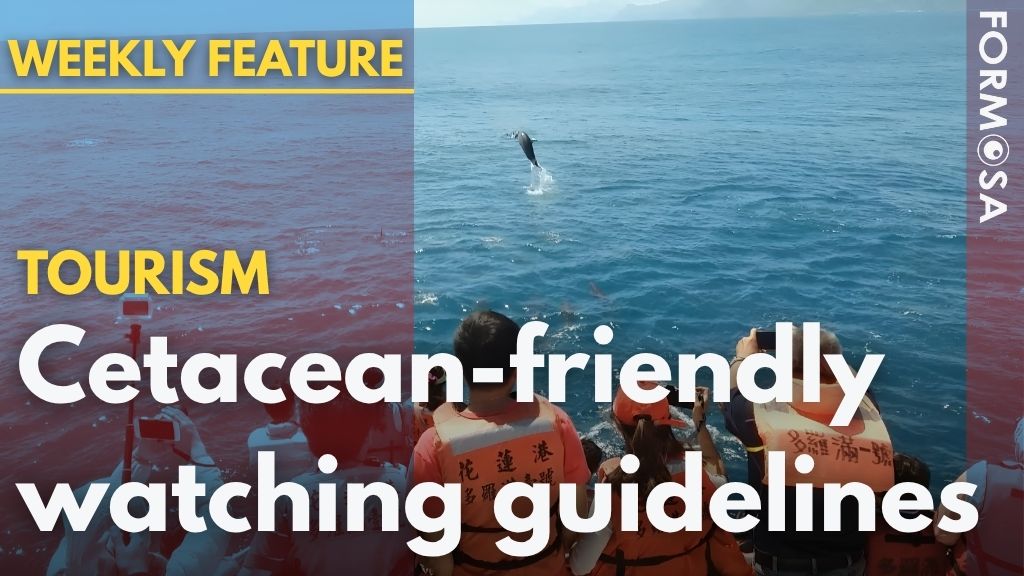
Activists and operators support cetacean-friendly watching guidelines
It’s summer, and many people are planning to spend time by the sea. Whale-watching is a popular summer activity offered in Yilan, Hualien and Taitung from April to October every year. Since the first whale-watching tour in 1997, operators have served more than 1 million visitors as of 2023. To minimize disturbance to the animals, the Ocean Conservation Agency introduced Friendly Cetacean Watching Guidelines and certification in 2022. Let’s find out more in our weekly feature.
On a whale-watching boat departing from the Port of Hualien, pilot whales can already be spotted less than half an hour on sea. Under the sun, their slick bodies are even more radiant. Meanwhile, another group of svelte swimmers also appears.
They’re Risso’s dolphins, known for their white cross-hatched stripes. Their distinctive stripes are scars from preying and fighting with each other. In Taiwan, they only show up with pilot whales at the same time in the eastern seas.
Although sightings of cetaceans are quite common in Eastern Taiwan, it doesn’t mean it’s guaranteed.
We’ve now left Hualien and arrived at Yilan’s Wushi Harbor. Again, we boarded a whale-watching boat, but this time we didn’t see any dolphins or whales.
Ms. Hsieh
Tourist
It’s just my luck, but all three times I’ve gone on whale-watching tours recently I didn’t get to spot any. But that said, if there’s a chance, I’ll probably come and do this again.
Whether off Yilan or Hualien, because the Kuroshio Current passes through the east of Taiwan, there are plenty of food sources for cetaceans. Additionally, the ocean far out is hundreds of meters deep, creating the ideal environment for them to reside and hunt. According to statistics, more than 32 types of cetaceans are active around Taiwan, and in Hualien alone there are around 21 types.
Lin Dong-liang
Kuroshio Ocean Education Foundation
It’s really quite numerous, because globally there are only around 90 types of cetaceans, meaning that with 21 species in Hualien, it’s almost a quarter of all cetaceans, which is really quite something. There’s a 50% chance of sighting spinner dolphins. Basically it’s quite likely you’ll get to see spinner dolphins when you go out to whale-watch.
Although commonly known as either dolphins or whales, they’re actually both cetaceans, so it’s not about the size.
Lin Dong-liang
Kuroshio Ocean Education Foundation
Biologists have their classification system, and of course their method is more meticulous. You get toothed whales and baleen whales. They’re identified and classified according to their distinct characteristics. What we may know as whales or dolphins are all cetaceans or “whales” in general.
The first whale-watching tour in Taiwan departed from Hualien’s Ciyafangan fishing harbor in 1997. Since then, whale-watching tours has become a popular tourist activity, with more than 1 million counts of people having gone on such outings by 2023. Apart from Hualien and Yilan, whale-watching tours are now also offered in Taitung. Although a boon for the tourism, it’s not so great for the animals themselves.
In 2020, a tourist on a whale-watching boat recorded this footage of a speedboat ramming right at a pod of dolphins. The dolphins were frightened and dove. The incident was reported to the Yilan County Government with the video as evidence, and the speedboat operator got fined NT$20,000 and deferred prosecution by one year in accordance with the Act on Wildlife Conservation.
Wu Long-jing
Ocean Conservation Administration deputy head
That of course created a deterrent effect later on, so nothing like this ever happened again recently.
In recent year, tour operators are also restraining themselves. To prevent having too many ships going out at once, which would disturb cetaceans, operators at Yilan’s Wushi Harbor would first send out one ship to search for sightings. Other operators will be notified after a pod is spotted, and they’ll all head out to see it, making tours more efficient. Whereas in Hualien, operators take turns sending out a boat every half an hour, and notify others when there’s a sighting.
Tseng Cheng-tsun
Taiwan Cetacean Society secretary-general
The two different methods make whale-watching very different. One relies on chance, so in Hualien you rely on luck. But in Yilan, someone helps you look for them, and once you find them, it’s not about luck anymore. There will always be something there to watch.
In addition to information sharing, keeping distance with the animals is also an important point of friendly cetacean watching guidelines.
But in the end, it all depends on the operators’ conscience. Law enforcement is difficult on sea. A report can only be formalized with a video evidence.
Yang Wei-cheng
NTU Veterinary Medicine professor
It’s not possible to have police officers at sea at all times, or have law enforcement regulate the ships, so I believe it’s very different from law enforcement on land.
Lin Dong-liang
Kuroshio Ocean Education Foundation
I think this is something that could be revised in the friendly cetacean watching guidelines. The 300m rule applies to large whales internationally. But the pilot whales we saw today are only around 6m long. When it comes to those smaller cetaceans, we often do have to get closer.
The safe distance depends largely on the size of cetaceans spotted. But due to insufficient funding, there is a research gap in this area.
Yang Wei-cheng
NTU Veterinary Medicine professor
When we’re aware that being too close to dolphins will impact them, the question that follows is, why does it affect them? Is it because the noise volume is too high? Or is it because dolphins can see the whale-watching ships? Is the interference visual or aural? That’s what we want to know.
Apart from operators, the general public must also gain a deeper understanding of the ocean. The Ocean Conservation Administration introduced a touring lecture series for parents and kids to learn about the ocean together. In one class, the lecturer used Kundt’s tubes to simulate how sound waves travel through water. The method shows children clearly, that sound travels much faster through water than through air.
Kuo
Lecture series participant
Marine animals that communicate with sounds will be affected. I used to think it’s quite under the ocean.
Chiu Shan-lin
Lecture series participant
We must protect the ocean and not create so much noise, otherwise it disturbs them.
Cetaceans communicate through sounds. Therefore, if noise levels are too high, they could lose their sense of direction. To escape from the threatening situation, they may leap out of the ocean out of duress. The scene may be exciting for whale-watchers, but the animals are actually feeling stressed.
Yang Wei-cheng
NTU Veterinary Medicine professor
There was a whale-watching group that had ships form a semi-circle, and dolphins started leaping in the middle. They were leaping because they wanted to escape, because they were being entrapped. Underwater, the humming noises from the ships interfere with their sense of direction and make them confused.
Some eco-conscious operators are responding by lengthening each session from two hours to a half-day. They hope to change the mindset of tourists, so each trip is no longer about whale-watching, but to experience the ocean’s diversity.
Lu Shih-ming
Whale-watching tour operator
Someone left us a one-star review. They wrote that our tours were really tedious, because we wouldn’t go near the whales and dolphins, and that our tour guide even told them that they need to learn to wait patiently and really get to understand the ocean. They said it’s rubbish, because they paid to see the whales and dolphins.
Not everyone is happy with cetacean-friendly operating models. But Lu Shih-ming wants to serve customers that share his responsibility for the ocean.
Lu Shih-ming
Whale-watching tour operator
Consumers that agree with this concept and support you in following the guidelines—these are my clientele. Actually, all fishermen are aware how we should maintain a good relationship with whales and dolphins. What needs to change is to make more tourists accept this way of doing things. I believe with the promotion of cetacean-friendly guidelines, more and more people will come to embrace it.
Tseng Cheng-tsun
Taiwan Cetacean Society secretary-general
Whales and dolphins belong to nature. People should be aware that when you go out to sea, you’re visiting their home. They may not necessarily be home. So you should be open to that possibly and not pressure the ship captain.
Cetacean friendly watching guidelines are not only for operators, tourists should also embrace them. That way, Taiwan’s waters will reciprocate with more abundance for everyone to enjoy.
For more Taiwan news, tune in:
Mon to Fri at 9:30 pm on Channel 152
Tue to Sat at 1 am on Channel 53
#dolphins #whales #whalewatching #marinelife #beachlover #cruise #taiwantravel #hualien #yilan
2025-08-15